


In any pipeline system — whether transporting water, hydrocarbons, steam, or chemicals — fluid must flow in a controlled, predictable direction. When flow reverses unexpectedly, the consequences can be severe:
This is precisely why non-return check valves exist: they are the pipeline’s automatic safety barrier against reverse flow, operating without manual intervention or external control. For a deeper look at check valve selection specifics (swing vs dual plate), see our companion guide: Selecting the Right Check Valve: Critical Considerations for Pipeline Protection.
(All images are sourced from the internet. In the event of any copyright infringement, please contact us and we will remove the content promptly.)
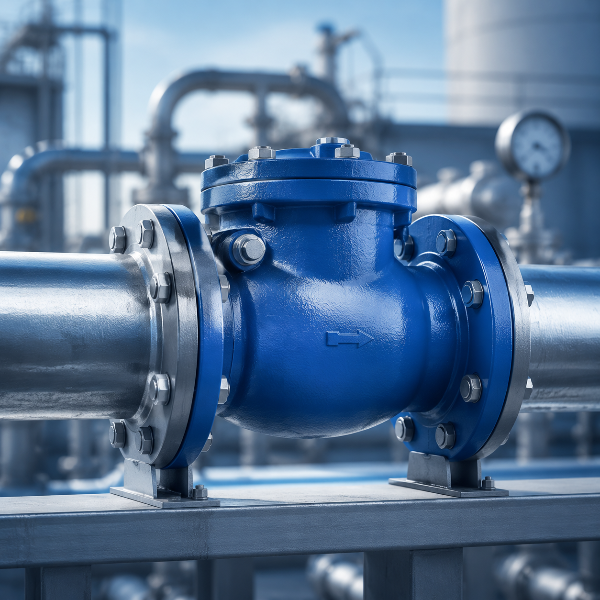
A non-return check valve (NRV) — also called a check valve, one-way valve, or backflow preventer — is a self-acting valve that allows fluid to pass in one direction only. It opens when upstream pressure exceeds downstream pressure, and closes automatically when the pressure differential reverses or equalizes.
Unlike ball valves or gate valves that require manual or actuated operation, check valves function passively. They have no handle, no actuator, and no control signal. Their operation is governed entirely by the physics of fluid pressure and the valve’s internal closing mechanism — whether that’s gravity, a spring, or back-pressure itself.
This simplicity makes them indispensable — but it also creates a fundamental limitation that many engineers overlook: a check valve can only prevent backflow. It cannot fully isolate a pipeline section, provide bidirectional sealing, or shut off flow on demand. Understanding both capabilities and limitations is key to correct pipeline valve specification.
Every check valve has two ports — an inlet and an outlet — and an internal closing mechanism (disc, ball, plate, or piston) that moves between open and closed positions based on differential pressure.
The key concept is cracking pressure — the minimum upstream pressure required to lift the closing mechanism off its seat and allow detectable flow. Cracking pressure varies by valve design:
When flow pressure drops below the cracking threshold — whether due to pump shutdown, a pressure surge downstream, or system depressurization — the closing mechanism returns to its seat and the valve seals, blocking reverse flow.
The speed of closure is critical. Fast-closing valves (spring-loaded, dual plate) minimize the window for reverse flow and reduce water hammer risk. Slow-closing valves (swing check in large-diameter lines) may allow brief reverse flow before seating, which can generate pressure transients — this is why FTK’s API 6D Pipeline Swing Check Valve offers optional dashpot devices to control disc closing time on large-diameter installations.
Pipeline engineers encounter five primary check valve types, each with distinct advantages depending on pressure, flow rate, orientation, and media compatibility.
Swing Check Valve
A hinged disc swings open with forward flow and closes by gravity when flow reverses. Best for horizontal pipelines with steady, low-velocity flow. FTK manufactures three swing check series: API 6D Pipeline Swing Check Valve (full-opening for pigging, optional dashpot for water hammer), BS 1868 Swing Check Valve (wide size/pressure range, large stock), and SS 316 Swing Check Valve (API 603, chemical & food service).
Common in: water distribution, wastewater, large-diameter low-pressure lines, pigging pipelines
Dual Plate (Wafer) Check Valve
Two spring-loaded half-discs pivot open with flow and snap shut against reverse flow. Compact, lightweight, and fast-closing — ideal for space-constrained installations and water hammer prevention. FTK’s Dual Plate Check Valve meets API 594/API 6D standards, available in a wide range of sizes with large stock for quick delivery.
Common in: HVAC, oil & gas, large-diameter pipelines, modular skid systems
Lift Check (Piston) Valve
A disc or piston lifts vertically off its seat with forward flow and drops back when flow stops. Suitable for high-pressure systems and vertical installations with upward flow. Higher pressure drop than swing types. FTK offers the DIN EN Lift Piston Check Valve per EN 13709, with DIN/EN end connections for European-standard pipeline projects.
Common in: high-pressure steam, gas systems, vertical piping, European-standard projects
Pressure Seal Bonnet Check Valve
Designed for high-temperature, high-pressure services mainly encountered in nuclear and fossil fuel power plants. Compared with bolted bonnet valves, pressure seal designs are less complicated and provide excellent sealing with minimum maintenance. FTK’s Pressure Seal Bonnet (PSB) Check Valve complies with BS 1868/API 6D/ASME B16.34.
Common in: power generation (nuclear/fossil), high-pressure steam, high-temperature service
Forged Steel Check Valve
Small-diameter forged steel check valves for high-pressure, compact process lines. Available with bolted bonnet or welded bonnet, and optionally with bellows seal for zero-leakage service. FTK’s Bolted Cover Forged Check Valve per API 602/BS 5352 covers the full small-bore range.
Common in: compact process lines, small-bore high-pressure systems, instrument connections
Spring-Loaded (In-Line) Check Valve
A spring holds the disc shut until forward flow overcomes the spring force. Opens and closes rapidly, minimizing reverse flow window. Can be installed in any orientation — horizontal, vertical up, or vertical down.
Common in: compact process lines, domestic plumbing, fast-closure applications
As a full-spectrum industrial valve manufacturer, FTK Valve produces seven distinct check valve series — each engineered for a specific set of pipeline conditions. Here’s a quick selection guide to help you match your project requirement to the right FTK model:
| FTK Model | Standard | Best For | Key Feature |
|---|---|---|---|
| API 6D Pipeline Swing Check Valve | API 6D | Long-distance pipelines requiring pigging capability | Full opening for pig passage; optional dashpot for water hammer control on large sizes |
| BS 1868 Swing Check Valve | BS 1868 | General industrial — oil & gas, water, steam | Wide size/pressure/material range; large stock for quick delivery |
| Pressure Seal Bonnet PSB Check Valve | BS 1868 / API 6D / ASME B16.34 | High-temperature, high-pressure (power plants) | Pressure seal design — simpler construction, excellent seal, minimal maintenance |
| SS 316 Swing Check Valve | API 603 / ASME B16.34 | Chemical, food, cryogenic service | 316 stainless steel; cost-effective lightweight design; extended bonnet for cryogenic |
| Dual Plate Check Valve | API 594 / API 6D | Space-constrained, fast-closure, HVAC & modular skids | Wafer-style compact body; spring-assisted fast closing; large stock available |
| DIN EN Lift Piston Check Valve | EN 13709 | European-standard projects, high-pressure vertical piping | DIN/EN end connections; piston-type closure for higher pressure applications |
| Bolted Cover Forged Check Valve | API 602 / BS 5352 | Small-bore high-pressure, instrument connections | Forged steel body; bolted or welded bonnet; optional bellows seal for zero leakage |
If your pipeline requires only backflow prevention, one of these seven FTK check valve series will likely meet the requirement. But when your specification demands capabilities beyond what a check valve can deliver — bidirectional sealing, on-demand shut-off, or zero-leakage isolation — the following sections explain why and how to upgrade to FTK’s ball valve or gate valve solutions.
Non-return valves appear across virtually every pipeline-dependent industry. Here are the most common application zones — with the FTK check valve series best suited to each:
| Industry | NRV Function | Recommended FTK Model |
|---|---|---|
| Water Treatment | Prevent treated water from flowing back into untreated reservoirs | BS 1868 Swing Check, Dual Plate |
| Chemical Processing | Prevent cross-contamination between process streams | SS 316 Swing Check |
| Oil & Gas Pipelines | Protect compressors and maintain unidirectional hydrocarbon flow | API 6D Pipeline Swing Check, Dual Plate |
| Power Generation | Prevent backflow in steam, condensate, and cooling water lines | PSB Check Valve, BS 1868 |
| Pump Stations | Maintain pump prime and prevent reverse rotation on shutdown | Dual Plate, Spring-loaded |
| HVAC Systems | Prevent chilled/heated water from circulating in the wrong direction | Dual Plate (Wafer) |
Here is the engineering reality that many specification documents gloss over: a check valve prevents reverse flow, but it does not — and cannot — provide full pipeline isolation. This applies to every check valve type, regardless of brand or standard — including all seven FTK check valve series.
Three scenarios where a check valve alone falls short:
Scenario 1: Bidirectional Sealing Required
When a pipeline section must be completely isolated from both directions — for maintenance, emergency shutdown, or section testing — a check valve’s unidirectional design cannot seal against forward pressure from the downstream side. This is where FTK’s DBB (Double Block and Bleed) ball valves become essential.
Scenario 2: Zero-Leakage Isolation
Check valves — even well-maintained ones — are not designed for zero-leakage sealing. In chemical, toxic, or volatile fluid pipelines where any leakage is unacceptable, FTK’s bellows-sealed gate valves provide the hermetic isolation that check valves cannot.
Scenario 3: On-Demand Shut-Off
A check valve is purely reactive — it closes only when flow reverses. If an operator needs to intentionally stop forward flow (for process control, emergency isolation, or system startup sequence), only a manually or actuated valve — an FTK trunnion-mounted ball valve or bellows-sealed gate valve — can provide that capability.
The good news: since FTK Valve manufactures check valves, ball valves, and gate valves under one roof, you can source both the backflow prevention and isolation components from a single ISO 9001 certified supplier — simplifying procurement, ensuring standard compatibility, and reducing lead time.
Understanding the purpose of each valve type helps engineers specify the right component for each pipeline function. Here’s a direct comparison — all three valve types available from FTK Valve:
| Feature | Check Valve (NRV) | Ball Valve | Gate Valve |
|---|---|---|---|
| Primary Function | Prevent backflow (unidirectional) | Full shut-off (bidirectional) | Full shut-off (bidirectional) |
| Operation | Automatic (pressure-driven) | Manual or actuated (90° turn) | Manual (multi-turn rising stem) |
| Bidirectional Sealing | No | Yes (SPE/DPE seats) | Yes (bellows or packing) |
| On-Demand Shut-Off | No | Yes | Yes |
| Leakage Class | Not rated for zero leakage | ISO 15848 / API 6D tight | Bellows = zero leakage |
| Water Hammer Risk | Depends on closing speed | Low (slow closure) | Low (slow closure) |
| Emergency Sealant | No | Yes (FTK DBB valves) | Limited |
| Pressure Drop (Open) | Low to moderate | Very low (full bore) | Low (full bore when open) |
| Standards | API 594, API 6D, BS 1868, EN 13709 | API 6D, API 607, ISO 15848 | API 600, API 602, API 603 |
| Best Pipeline Use | Pump protection, backflow prevention | Pipeline isolation, ESD, DBB | Zero-leakage isolation, steam lines |
The key takeaway: check valves and shut-off valves are not interchangeable. They serve fundamentally different pipeline functions. A well-designed pipeline system often uses both — FTK check valves for automatic backflow protection, and FTK ball valves or gate valves for intentional isolation and shut-off.
If your pipeline specification calls for any of the following, a check valve alone — even the best-engineered one — will not meet the requirement:
FTK’s API 6D Pipeline Ball Valve provides bidirectional sealing through SPE (Single Piston Effect) and DPE (Double Piston Effect) seating — a feature that check valves fundamentally lack. When pipeline pressure is applied from either direction, the DPE seats energize to maintain a tight seal, ensuring complete isolation.
For applications requiring even greater safety redundancy, the DBB Double Block and Bleed Ball Valve offers two independent sealing barriers plus a bleed port to verify isolation integrity — the gold standard for pipeline section isolation.
In steam lines, chemical pipelines, and toxic service where any leakage is unacceptable, FTK’s bellows-sealed gate valve replaces the traditional packing gland with a multi-ply metal bellows assembly. This creates a hermetic seal between the valve body and the stem — eliminating the fugitive emission pathway that conventional gate valves and all check valves share. Read the full comparison: Bellows Sealed Gate Valve vs Packing Seal.
Use this decision table to match your pipeline requirement to the correct valve type and FTK product:
| Pipeline Need | Recommended Valve | Key Feature | FTK Product |
|---|---|---|---|
| Backflow prevention — pipeline pigging | Swing check valve (API 6D) | Full opening, optional dashpot | API 6D Swing Check |
| Backflow prevention — general industrial | Swing check valve (BS 1868) | Wide size/pressure range, stocked | BS 1868 Swing Check |
| Backflow prevention — corrosive service | SS 316 swing check valve | 316 SS, API 603 | SS 316 Swing Check |
| Backflow prevention — compact/fast close | Dual plate check valve | Wafer-style, spring-assisted | Dual Plate Check Valve |
| Backflow prevention — high-temp/high-pressure (power) | Pressure seal bonnet check valve | PSB design, minimal maintenance | PSB Check Valve |
| Backflow prevention — European standard | Lift piston check valve | EN 13709, DIN/EN connections | DIN EN Lift Piston Check |
| Backflow prevention — small-bore forged | Forged steel check valve | API 602, optional bellows seal | Forged Check Valve |
| Bidirectional pipeline shut-off | Trunnion ball valve | SPE/DPE bidirectional sealing | API 6D Pipeline Ball Valve |
| Double isolation + bleed verification | DBB ball valve | Two seals + bleed port | DBB Ball Valve |
| Zero-leakage isolation | Bellows-sealed gate valve | Metal bellows, no packing leak | Bellows Sealed Gate Valve |
A non-return check valve (NRV) is an automatic valve that allows fluid to flow in one direction only, preventing reverse flow. In pipelines, it protects pumps, compressors, and system integrity from backflow damage. Explore FTK’s seven check valve series for standard and custom specifications.
A check valve operates automatically and only prevents backflow (unidirectional). Ball and gate valves require manual or actuated operation and provide bidirectional shut-off — meaning they can seal from both directions and intentionally stop flow. See our API 6D Pipeline Ball Valve for bidirectional isolation.
FTK produces seven check valve series: API 6D Pipeline Swing Check (for pigging), BS 1868 Swing Check (general industrial), PSB Check Valve (power generation), SS 316 Swing Check (chemical/food), Dual Plate Check (compact/fast-closing), DIN EN Lift Piston Check (European standard), and Forged Check Valve (small-bore/API 602).
No. Check valves are designed exclusively for unidirectional backflow prevention. For bidirectional sealing, trunnion-mounted ball valves with SPE/DPE seating are the correct specification.
When the pipeline requires zero-leakage isolation, bidirectional shut-off, or on-demand flow control. FTK’s bellows-sealed gate valves provide hermetic sealing that check valves cannot achieve. See Bellows Sealed Gate Valve vs Packing Seal for details.
SPE (Single Piston Effect) seals in one direction only, while DPE (Double Piston Effect) seals in both directions using line pressure to energize the seats. DPE seating gives trunnion ball valves true bidirectional sealing — essential for pipeline isolation where check valves cannot perform. Read our full SPE vs DPE guide.
Fast-closing check valves (dual plate, spring-loaded) reduce water hammer risk by closing before reverse flow gains momentum. Slow-closing types (swing check) may actually contribute to water hammer — which is why FTK’s API 6D Pipeline Swing Check Valve offers optional dashpot devices. For a detailed analysis, see Selecting the Right Check Valve.
The pipeline section will not be fully isolated. A check valve cannot seal against downstream pressure or intentionally stop forward flow, creating safety risks during maintenance and emergency shutdown. For true isolation, specify an FTK DBB Double Block and Bleed Ball Valve.
Water treatment, oil & gas, chemical processing, power generation, and pump station infrastructure are the highest-volume users. FTK serves all of these sectors — explore our Water Treatment and Chemical Industry application pages.
Yes. FTK Valve manufactures check valves, ball valves, and gate valves under one ISO 9001 certified facility. This simplifies procurement, ensures standard compatibility across your pipeline valve package, and reduces lead time. Contact FTK’s engineering team for project-specific guidance.
Non-return check valves are essential pipeline components — they provide automatic, reliable backflow prevention that protects pumps, prevents contamination, and maintains system integrity. FTK Valve’s seven check valve series cover virtually every pipeline scenario, from API 6D pigging lines to high-pressure power plants to corrosive chemical service.
But their purpose is specific and limited: they are unidirectional safety barriers, not isolation devices. When a pipeline specification demands bidirectional sealing, on-demand shut-off, zero-leakage performance, or double block and bleed capability, engineers must specify shut-off valves — FTK’s trunnion-mounted ball valves with SPE/DPE seating for bidirectional isolation, or bellows-sealed gate valves for hermetic zero-leakage applications.
The most robust pipeline designs use both: FTK check valves for passive backflow protection at pump discharge lines and branch connections, and FTK ball valves or gate valves for active isolation at critical section boundaries.
As an ISO 9001 certified manufacturer with over a decade of global pipeline experience, FTK Valve provides the full spectrum — from seven check valve series for backflow prevention to DBB ball valves for pipeline isolation and bellows-sealed gate valves for zero-leakage service — all under one roof.
Need the Right Valve for Your Pipeline Project?
Whether you need a swing check valve for backflow protection, a dual plate check valve for compact installations, a trunnion ball valve for bidirectional isolation, or a bellows-sealed gate valve for zero-leakage service — FTK’s engineering team can guide your specification from a single ISO 9001 certified source.
FULL-THINK VALVE CO., LTD | ISO 9001 Certified | Wenzhou, China | Established 2012
Products conform to ANSI, ASME, API, BS/EN, DIN/EN, GB, and GOST standards. www.ftk-valve.com
 Optimized by Seraphinite Accelerator