

In high-pressure midstream oil and gas pipeline networks governed by the API 6D specification, valve failure is not an option. While housing materials and flange tolerances are critical, the ultimate field safety of a heavy-duty upstream valve depends entirely on its seat engineering logic. Specifically, the choice between Single Piston Effect (SPE) vs. Double Piston Effect (DPE) Seating in API 6D Ball Valves determines how a pipeline handles emergency medium isolation and thermal fluid expansion.
Understanding these two dynamic piston seat designs is essential for preventing catastrophic pipeline rupture and maintaining a zero-leakage barrier. Since its establishment in 2012, FTK, a world-class industrial valves manufacturer, has supplied engineered sealing configurations for severe-service infrastructure. As an authoritative Industrial Valve Supplier, we provide this comprehensive engineering analysis to clarify SPE and DPE fluid mechanics.
(All images are sourced from the internet. In the event of any copyright infringement, please contact us and we will remove the content promptly.)
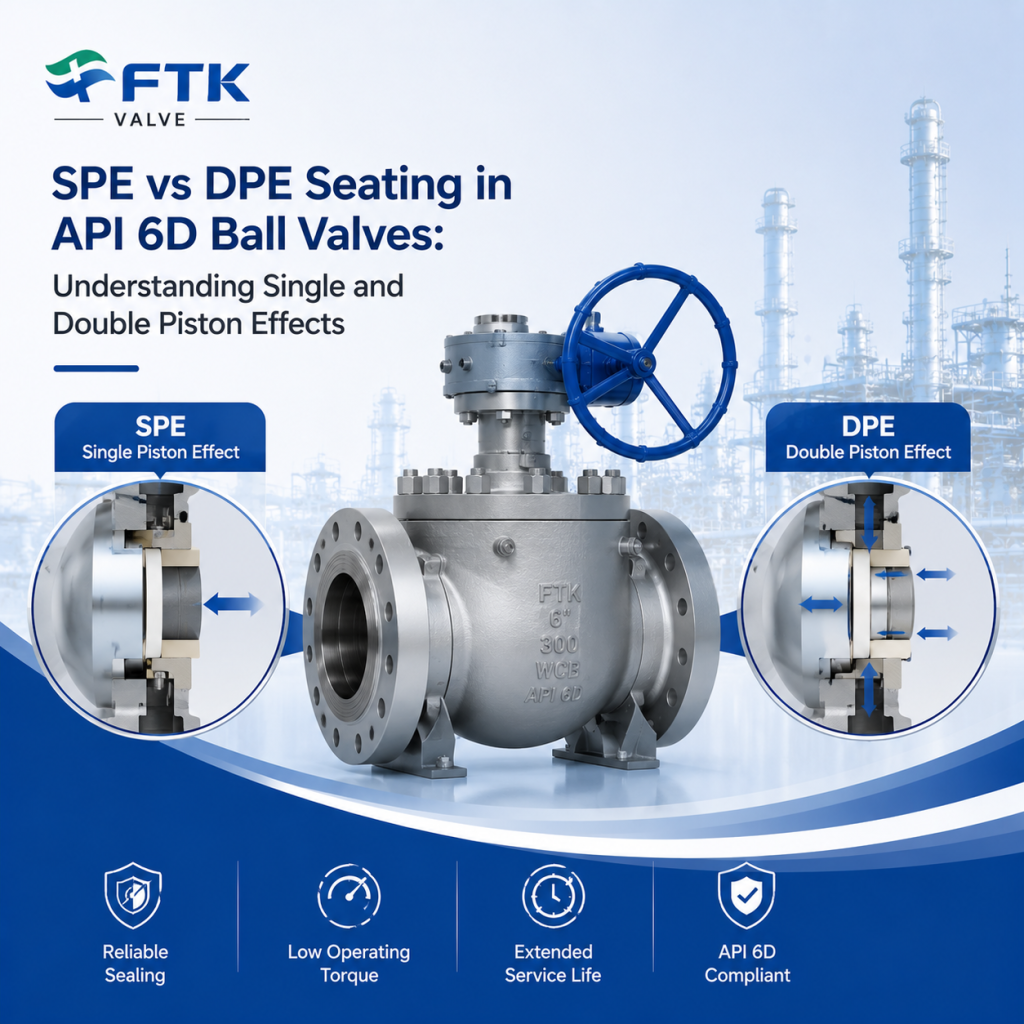
Unlike floating ball valves where the line pressure pushes the entire ball against a downstream seat, a Trunnion Mounted Ball Valve utilizes spring-loaded, dynamic floating seats. These seats behave like pistons. When fluid pressure acts upon the outer shoulder areas of the seat ring, it creates a differential force vector ($F_s$) that shifts the seat face tightly against the sphere, forming a bubble-tight seal.
Depending on how the seat’s geometric seals (O-rings or lip seals) are positioned within the machining pocket, this fluid force can act in one direction or two directions. This is the exact boundary dividing SPE and DPE architectures.
The Single Piston Effect (SPE) design is the standard, default seat configuration for the majority of midstream pipelines. It is frequently referred to in engineering specifications as a Self-Relieving Seat.
In an SPE seat ring, the geometric seal is positioned such that upstream line pressure forces the seat to push tighter against the ball. However, if the valve is closed and medium trapped inside the valve body cavity undergoes thermal expansion (due to solar radiation or nearby machinery heat), the pressure inside the cavity rises exponentially.
When this cavity pressure exceeds the pipeline pressure plus the initial spring pre-load (typically by 2 to 7 Bar), the force vector flips. The cavity pressure pushes the seat away from the ball, allowing the excess pressure to automatically bleed off back into the pipeline channel. This mechanism prevents explosive decompression within the valve casing.
Primary Advantages of SPE Configurations:
When a pipeline network demands an absolute bi-directional barrier—such as in critical chemical refining, high-risk gas storage, or multi-product manifolds—engineers upgrade to Double Piston Effect (DPE) seating, also known as a Double Isolation Seat (DIS).
The geometry of a DPE seat ring is designed so that regardless of where the pressure originates (from the pipeline channel or from inside the central body cavity), the resultant force vector always pushes the seat ring toward the ball.
If the upstream seat fails or suffers erosion from abrasive debris, the downstream DPE seat ring reacts to the incoming fluid by sealing even tighter against the sphere. This provides a true redundant backup barrier, ensuring absolute isolation even if one side of the valve is completely compromised.
By combining SPE and DPE seats on opposite sides of a single Trunnion Mounted Ball Valve, industrial valves suppliers can deliver highly specific safety ratings defined under API 6D:
Seat logic must always be paired with correct material selection. For standard DBB applications, FTK utilizes glass-reinforced RPTFE to maintain low torque requirements. However, for deep-well crude extraction or high-pressure gas headers, specifying a PEEK Seat Trunnion Valve ensures the rigid polymer can withstand the intense mechanical seating forces required by DIB double-piston configurations without extrusion.
To assist your design team in checking whether your system requires a DBB, DIB-1, or DIB-2 valve setup, utilize our factory engineering selector tool below:
Map your pipeline safety requirements to the correct SPE/DPE setup.
Recommended API 6D Code & Seat Layout
No. SPE and DPE seat rings have entirely different cross-sectional dimensions and geometric O-ring grooves. Modifying the seat logic requires replacing the entire internal seat kit and potentially re-machining the valve body pocket, which must be executed by an authorized valves manufacturer.
Because a DIB-1 valve uses two DPE seats, any pressure rising within the valve cavity pushes both seats tighter against the ball, locking the fluid inside. If solar heating causes thermal expansion of a trapped liquid, the pressure can easily exceed the casting limits, causing an explosive casing failure unless an external safety relief valve vents it.
Bi-directional sealing means the valve can seal fluid coming from either the upstream or downstream direction. Both DBB (SPE/SPE) and DIB (DPE/DPE) valves are bi-directional, but they handle internal cavity pressure in completely opposite ways.
A DIB-2 valve utilizes an SPE seat on the upstream side and a DPE seat on the downstream side. If cavity pressure surges, it easily forces the upstream SPE seat back into the line, relieving the pressure safely, while the downstream DPE seat remains a permanent solid wall protecting the downstream network.
For high-pressure sour gas service, an api 6d ball valve configured to DIB-1 or DIB-2 parameters complying with NACE MR0175 is preferred, ensuring double isolation barriers protect critical infrastructure hubs from toxic leakage.
Yes. Because DPE seats utilize line pressure to continually press harder against the sphere from both sides, the friction is significantly higher than that of an SPE system, requiring the automated actuator safety factor multiplier to be increased.
No. Floating ball valves rely on the entire ball shifting downstream to compress a static seat ring. Piston-effect seating (SPE/DPE) relies on independent dynamic spring-loaded seat rings, which are an exclusive feature of a heavy-duty Trunnion Mounted Ball Valve.
Because DIB systems serve in critical service nodes, we recommend executing a body cavity bleed test via the drain valve every six months to verify that neither seat ring has suffered wire-drawing or particle erosion.
For ANSI Class 900 and above, PEEK or Devlon V-API inserts are highly recommended. Soft pure PTFE will rapidly extrude under the double-piston load vectors exerted by high line pressures.
Since 2012, FTK has maintained complete trace-material logging, ultrasonic casing tests, and precision coordinate inspection for all custom SPE and DPE seating systems, ensuring full compliance with high-tier oil and gas engineering specifications.
Specifying the correct seat logic for your pipeline is a decision that balances absolute isolation security against system over-pressure management. For standard lines, the self-relieving SPE (DBB) design delivers simple, autonomous protection. For high-risk isolation protocols, the absolute safety wall of a DPE (DIB) blueprint is necessary, provided cavity venting is engineered correctly.
Since its founding in 2012, FTK has served as an elite valves manufacturer and dedicated technical partner. Our engineering desk is prepared to assist you in designing custom valve matrices that protect your operational bottom line. Visit our contact-us page today to submit your specific pressure, temperature, and media data sheets for a verified engineering configuration.