


From shell test pressures to seat leakage allowances — a technical deep-dive into what API 598 requires, how it compares to ISO 5208 and MSS SP-61, and how to verify compliance on your next valve procurement.
Published: July 2026 | Reading Time: ~15 min | API 598:2023 (11th Edition)
FTK Valve Engineering Team
FULL-THINK VALVE Co., Ltd — ISO 9001 certified industrial valve manufacturer since 2012. All products tested per API 598, API 6D, BS 6755, EN 12266, and ISO 5208 as applicable. Serving oil & gas, petrochemical, power, and water treatment industries worldwide.
API 598 — titled Valve Inspection and Testing — is a standard published by the American Petroleum Institute (API) that specifies the inspection and pressure testing requirements for industrial valves. It defines how manufacturers must verify valve integrity before delivery, establishing consistent, measurable criteria for what constitutes a “passing” or “failing” valve.
The current edition is API 598:2023 (11th Edition), published February 2023, superseding the 2016 10th Edition. Key updates in the 11th Edition include revised leakage rate tables, updated test duration requirements, and new provisions for DBB (Double Block and Bleed) pressure testing.
It is critical to understand that API 598 is a testing standard, not a design standard. It does not specify valve geometry, material selection, pressure-temperature ratings, or fitness for service. Its sole purpose is to define how valves are inspected and pressure-tested after manufacturing — or after repair/refurbishment. Valve design is governed by separate product standards such as API 6D (pipeline valves), API 600 (steel gate valves), API 602 (forged steel valves), and ASME B16.34 (pressure-temperature ratings).
📌 Typical Specification Stack
API 600/API 602 → Valve design | ASME B16.34 → Pressure-temperature ratings | API 598 → Final inspection and pressure testing
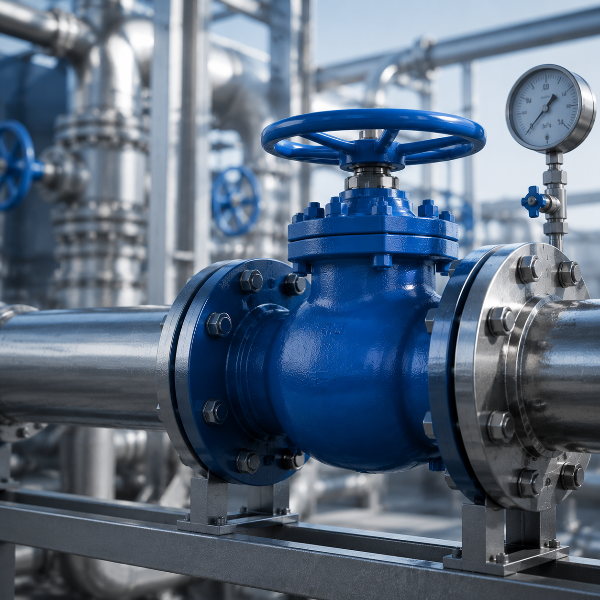
(All images are sourced from the internet. In the event of any copyright infringement, please contact us and we will remove the content promptly.)
API 598 applies to six major valve types, regardless of seat material:
| Valve Type | Primary Function | Typical Application | FTK Product |
|---|---|---|---|
| Gate Valve | On/off isolation | Refinery, pipeline, process | Bellows seal gate valves |
| Globe Valve | Throttling / flow regulation | Steam, cooling water | — |
| Check Valve | Prevent reverse flow | Pump/compressor discharge | 7 check valve types |
| Ball Valve | Quarter-turn isolation | Oil & gas, LNG, petrochemical | Trunnion mounted ball valves |
| Plug Valve | Quarter-turn isolation | Chemical processing | — |
| Butterfly Valve | Large-diameter, utility service | Water, low-pressure process | — |
API 598 applies to all seat material categories: resilient-seated (PTFE, RPTFE, PEEK, elastomers), nonmetallic-seated (including ceramic), and metal-to-metal seated valves. The leak acceptance criteria differ significantly between these categories — a critical distinction covered in Section 9.
Note: API 598 does not apply to control valves, safety relief valves, or valves covered by separate product standards that specify their own testing requirements (e.g., API 6D pipeline valves may have testing requirements that differ from or supplement API 598).
The shell test (also called hydrostatic shell test or pressure integrity test) is the most fundamental API 598 requirement. Its purpose is to verify that the valve’s entire pressure boundary — body, bonnet, cover, end connections, and all permanent pressure-retaining joints — can withstand elevated pressure without structural failure or visible leakage.
Shell Test: Zero Visible Leakage
This zero-leakage requirement is absolute. Even a single visible drop from a body-to-bonnet joint, a flange connection, or a cast porosity site means the valve fails. There is no “allowable” shell leakage under API 598.
Adjustable stem seals (packing) that weep during the shell test are not automatically cause for rejection — but they must demonstrate the ability to retain rated working pressure after adjustment. Non-adjustable stem seals (fixed O-rings) must show zero visible leakage.
The backseat test verifies the sealing integrity of the backseat (upper seat) — the secondary metal-to-metal seal formed between the stem and the bonnet when the valve is in the fully open position. This feature exists only on rising-stem valves (gate valves and globe valves) and is specifically excluded for bellows-sealed valves.
Special rule for small valves: For DN ≤ 100 (NPS ≤ 4), the backseat test may be combined with the shell test, simplifying the testing sequence.
Check valves, ball valves, butterfly valves, and plug valves do not have backseat structures and therefore are not subject to backseat testing. FTK’s bellows seal gate valves are also exempt from backseat testing because the bellows provides the stem seal.
The low-pressure closure test — commonly called the air leakage test — is one of the most discussed and misunderstood API 598 requirements. It evaluates valve seat sealing performance at low gas pressure, which is more sensitive than liquid testing for detecting small leak paths.
| Parameter | Requirement |
|---|---|
| Test medium | Air, nitrogen, or inert gas |
| Test pressure | 5.5 ± 1.5 bar (80 ± 20 psig) — effective range 4.0–7.0 bar (58–102 psig) |
| Detection method | Bubble observation or calibrated volumetric device |
| Seat preparation | Seat surfaces must be clean — free of oil, grease, and sealant |
API 598 specifies which side of the valve receives test pressure during the closure test:
| Valve Type | Test Direction |
|---|---|
| Bidirectional gate valve | Test from each side sequentially, opposite side open to atmosphere |
| Globe valve | Pressure applied under the disc |
| Check valve | Pressure applied from downstream side |
| Unidirectional valve | Pressure from the marked directional side |
| API 609 Type A butterfly valve | Unidirectional test only |
| API 609 Type B butterfly valve | Bidirectional test |
Applicability by valve type: Floating ball valves and most resilient-seated valves require the low-pressure closure test as mandatory. Lubricated plug valves and API 609 Type A butterfly valves may treat it as optional depending on the specification.
The high-pressure closure test evaluates valve seat sealing at elevated pressure using liquid medium. It complements the low-pressure gas test by verifying seat integrity under conditions closer to actual operating pressure.
| Parameter | Requirement |
|---|---|
| Test medium | Liquid (typically water) |
| Test pressure | 110% of maximum allowable pressure at 38°C (100°F) — equivalent to 1.1× rated pressure |
| Leakage observation | Measured in drops per minute (liquid) |
| Butterfly valve special | Uses 110% of design differential pressure at 38°C |
Applicability: Mandatory for lubricated plug valves and most metal-seated valves. Optional for floating ball valves and resilient-seated valves where the low-pressure closure test already demonstrates zero leakage.
DBB testing: For Double Block and Bleed valves, API 598:2023 introduces two specific high-pressure closure test configurations — sequential (testing each seat independently) and simultaneous (pressurizing both cavities at once). The simultaneous test duration is at least twice the standard closure test duration.
API 598 defines test pressures based on the valve’s pressure rating, material, and the type of test being performed:
| Test Type | Pressure Formula | Example (Class 300) |
|---|---|---|
| Shell test (steel & alloy) | 1.5× rated pressure at 38°C, rounded up to next 25 psig | 1.5× 740 psig = 1110 psig → 1110 psig |
| Shell test (cast iron) | Specified minimum values per API 598 Table 2 | Material-specific fixed values |
| High-pressure closure | 1.1× max allowable pressure at 38°C | 1.1× 740 = 814 psig |
| Low-pressure closure | 5.5 ± 1.5 bar (80 ± 20 psig) | 4.0–7.0 bar (58–102 psig) |
| Backseat test | Same as shell test pressure | 1110 psig (Class 300) |
The rounding rule for shell test pressure is important: after calculating 1.5× rated pressure, round up to the next 25 psig increment. This ensures the test pressure never falls below the minimum required value.
For Class 800 valves (a special intermediate rating used with API 602 forged steel valves), shell test pressure is based on 1.5× the API 602 pressure-temperature rating rather than a standard ASME class rating.
API 598 specifies minimum test durations that increase with valve size. The timer starts only after the required test pressure has been fully reached and stabilized — not when pressurization begins.
| DN | NPS | Shell Test | Backseat Test | Check Valve Closure | Other Valve Closure |
|---|---|---|---|---|---|
| ≤ 50 | ≤ 2 | 15 s | 15 s | 60 s | 15 s |
| 65–150 | 2½–6 | 60 s | 60 s | 60 s | 60 s |
| 200–300 | 8–12 | 120 s | 60 s | 120 s | 120 s |
| 350–600 | 14–24 | 300 s | 60 s | 120 s | 120 s |
| > 600 | > 24 | 600 s | 120 s | 240 s | 240 s |
Key notes on duration requirements:
This is the most critical section of API 598 and the one most frequently referenced in procurement specifications. The standard establishes different leak allowances based on three variables: seat material category (resilient vs. metal), valve type (check valve vs. non-check valve), and test medium (liquid vs. gas).
Resilient & Nonmetallic Seats: Zero Leakage
All resilient-seated and nonmetallic-seated valves — regardless of type, size, or test medium — must show zero visible leakage during the minimum test duration:
This applies to PTFE, RPTFE, PEEK, elastomer, and ceramic seat materials. For FTK’s Dual Plate Check Valve and API 6D Pipeline Swing Check Valve with soft seat options, this zero-leakage criterion applies.
Metal-seated gate, globe, ball, plug, and butterfly valves have size-dependent leakage allowances. The permitted leakage increases with valve size, reflecting the practical reality that larger metal seating surfaces have proportionally more potential leak paths:
| NPS | Liquid (drops/min) | Liquid (mL/min) | Gas (bubbles/min) | Gas (mL/min) |
|---|---|---|---|---|
| ≤ 2 (≤ DN 50) | 0 | 0 | 0 | 0 |
| 6 (DN 150) | 12 | 0.75 | 24 | 0.24 |
| 12 (DN 300) | 24 | 1.50 | 48 | 0.48 |
Conversion factors: 1 mL (liquid) ≈ 16 drops | 1 mL (gas) ≈ 100 bubbles
Large valve formula (NPS > 48 / DN > 1200):
Metal-seated check valves receive significantly higher permitted leakage rates than other valve types. This is not a quality concession — it reflects the inherent design reality that check valves cannot achieve the same seat sealing precision as manually-operated isolation valves where the operator applies deliberate closing force:
| NPS | Liquid (mL/min) | Gas (m³/h) | Gas (ft³/h) |
|---|---|---|---|
| ≤ 2 (≤ DN 50) | 6 | 0.08 | 3 |
| 6 (DN 150) | 18 | 0.25 | 9 |
| 12 (DN 300) | 36 | 0.50 | 18 |
Large check valve formula (NPS > 48 / DN > 1200):
Comparison insight: A NPS 12 metal-seated check valve under liquid testing is allowed 36 mL/min — while a NPS 12 metal-seated gate valve of the same size is allowed only 1.50 mL/min. This 24× difference reflects the check valve’s reliance on gravity/flow for seating rather than operator-applied closing torque. For applications requiring tighter sealing, consider resilient-seated check valves or upgrading to a trunnion mounted ball valve with soft seats.
Use this consolidated reference for quick look-up of key API 598 test parameters:
| Test Type | Medium | Pressure | Min Duration (DN≤50) | Acceptance |
|---|---|---|---|---|
| Shell Test | Water (or gas) | 1.5× rated | 15 s | Zero visible leak |
| Backseat Test | Water | Same as shell | 15 s | Zero visible leak |
| Low-Pressure Closure | Air/N₂ | 5.5±1.5 bar | 15 s (60 s check) | Resilient: 0; Metal: size-dependent |
| High-Pressure Closure | Water | 1.1× rated | 15 s (60 s check) | Resilient: 0; Metal: size-dependent drops |
Understanding how API 598 compares to other valve testing standards is essential for international procurement, where specifications may reference multiple standards depending on project location and industry.
| Aspect | API 598 | ISO 5208 | MSS SP-61 |
|---|---|---|---|
| Publisher | American Petroleum Institute | ISO (International) | Manufacturers Standardization Society |
| Scope | Inspection + pressure testing (6 valve types) | Pressure testing (all metallic industrial valves) | Pressure testing (steel valves, open/close type) |
| Leakage system | Fixed pass/fail criteria per valve type/size | Rate A–G classification (7 classes) | Per-inch-diameter formula (cc/hr per inch) |
| Shell test pressure | 1.5× rated, rounded up | 1.5× rated (similar approach) | 1.1× 1000°F rated |
| Strictness | Strictest for oil & gas applications | More flexible; Rate D common in EU projects | Less strict than API 598 |
| Direct interchange? | ❌ No — cannot directly substitute ISO 5208 | ❌ No — different leakage classification | ❌ No — different pressure/duration criteria |
| Primary use | Oil & gas, refinery, petrochemical | EU/water/HVAC/general industrial | US general industrial (non-API projects) |
Critical warning: A valve that passes ISO 5208 Rate D (allows visible liquid drops) may fail API 598, which requires tighter leakage limits for the same valve type and size. When specifications reference both standards, verify which one governs the acceptance criteria — they are not directly interchangeable.
FTK’s European-standard DIN EN Lift Piston Check Valve (EN 13709) is tested per EN 12266/ISO 5208, while FTK’s API-standard products (all check valve product lines) are tested per API 598. FTK ensures the correct testing standard is applied based on the product’s design specification.
A valid API 598 valve test report should contain comprehensive data allowing full traceability and verification. Here are the essential elements and common red flags:
| Red Flag | What It Means |
|---|---|
| ⚠ Test marked “N/A” | Required test omitted without justification — e.g., backseat test missing for a rising-stem gate valve |
| ⚠ Leakage exceeds limits | e.g., 30 bubbles/min on closure test when API 598 allows 24 for that size — the valve fails |
| ⚠ No inspector signature | Uncertified test — no accountability for accuracy |
| ⚠ Duration too short | e.g., 45-second shell test for a DN 200 valve that requires 120 seconds minimum |
| ⚠ Wrong edition referenced | 2016 edition criteria applied to a 2023 specification — requirements may differ |
| ⚠ ISO 5208 used instead of API 598 | Standards not interchangeable — ISO Rate D pass may fail API 598 |
Every FTK valve product is pressure-tested before shipment. The testing standard applied depends on the product’s design specification:
| FTK Product | Design Standard | Testing Standard | Seat Options |
|---|---|---|---|
| API 6D Pipeline Swing Check Valve | API 6D | API 598 / BS 6755 | Soft seat (PTFE/RPTFE) + Metal seat |
| Dual Plate Check Valve | API 594 / API 6D | API 598 / EN 12266 | Spring-loaded; resilient + metal |
| BS 1868 Swing Check Valve | BS 1868 | API 598 / BS 6755 | Metal seat (standard) |
| Pressure Seal Bonnet PSB Check Valve | BS 1868 / API 6D / ASME B16.34 | API 598 / BS 6755 | Metal seat (high-pressure) |
| SS 316 Swing Check Valve | API 603 / ASME B16.34 | API 598 | Metal seat (stainless) |
| DIN EN Lift Piston Check Valve | EN 13709 | EN 12266 / ISO 5208 | Metal seat (piston-guided) |
| Bolted Cover Forged Check Valve | API 602 / BS 5352 | API 598 | Metal seat; bellows option |
| Trunnion Mounted Ball Valve | API 6D / API 600 | API 598 | Soft seat (PTFE/RPTFE/PEEK) + Metal seat |
Key insight for procurement: When specifying FTK products, verify that the testing standard matches your project requirements. Oil & gas projects typically require API 598; European projects may specify EN 12266/ISO 5208. FTK applies both standards where applicable, ensuring global compliance.
API 598 is the American Petroleum Institute’s standard for valve inspection and pressure testing. It covers six valve types: gate, globe, check, ball, plug, and butterfly valves with resilient, nonmetallic, or metal-to-metal seats. It specifies shell tests, backseat tests, and closure (seat leakage) tests. FTK’s complete check valve range is tested per API 598.
The shell test pressure is 1.5× the rated pressure at 38°C, rounded up to the next 25 psig increment. For example, a Class 300 valve rated at 740 psig tests at 1110 psig. The acceptance criterion is zero visible leakage on all pressure boundary surfaces. FTK’s BS 1868 Swing Check Valve and all other products undergo this test.
The low-pressure closure test uses air or inert gas at 5.5±1.5 bar (80±20 psig). Leakage is measured by bubble count or calibrated volumetric device. Resilient-seated valves must show zero bubbles; metal-seated valves have size-dependent allowances (e.g., 24 bubbles/min for NPS 6 metal-seated non-check valves). FTK’s spring-loaded Dual Plate Check Valve with resilient seats achieves zero leakage.
Three-tier system: (1) Resilient-seated = zero visible leakage (0 drops / <1 bubble); (2) Metal-seated non-check valves = size-dependent (0 drops for NPS ≤2, up to 2×NPS drops/min for large valves); (3) Metal-seated check valves = significantly higher allowances (3×NPS cm³/min liquid, 0.042×NPS m³/h gas). See the detailed tables in Section 9.
Minimum test durations range from 15 seconds (DN ≤ 50) to 600 seconds (DN > 600) for shell tests, and 15 seconds to 240 seconds for closure tests. Check valves always require at least 60 seconds for closure tests, regardless of size. See Section 8 for the full duration table.
The backseat test verifies the stem-to-bonnet metal seal when the valve is fully open. It applies only to rising-stem valves (gate and globe valves) — not to check valves, ball valves, or butterfly valves. Zero visible leakage is required. FTK’s bellows seal gate valves are exempt from backseat testing because the bellows provides the stem seal.
API 598 uses fixed pass/fail criteria per valve type and size. ISO 5208 uses a Rate A–G classification system where the purchaser selects the applicable rate. A valve passing ISO 5208 Rate D may fail API 598. The standards are not directly interchangeable. FTK’s API-standard products test per API 598; the DIN EN Lift Piston Check Valve tests per EN 12266/ISO 5208.
A valid report must include: valve identification (manufacturer, model, DN, class, serial number), materials specification, API 598 edition, tests performed, test medium/pressure/duration, measured leakage values with allowable limits comparison, instrument calibration status, operator signature, and witness stamps. Red flags: tests marked “N/A” without justification, leakage exceeding limits, missing signatures, or wrong edition. Contact FTK for complete test documentation.
Yes. All FTK product pages specify their testing standards: API-standard products (API 6D Pipeline Swing Check, BS 1868, Dual Plate, SS 316, PSB, Forged Check) are tested per API 598 / BS 6755. The DIN EN Lift Piston Check Valve is tested per EN 12266 / ISO 5208. FTK ensures the correct standard matches each product’s design specification. Explore the full FTK check valve range.
Oil & gas, refinery, and petrochemical projects typically mandate API 598. EU, water treatment, HVAC, and general industrial projects commonly reference ISO 5208 (typically Rate D). For zero-leakage critical applications, either standard works — API 598 (resilient seats) or ISO 5208 Rate A (equivalent to zero leakage). FTK provides products tested to both standards. Contact FTK engineers for specification guidance.
API 598 is the petroleum industry’s definitive standard for verifying valve integrity through pressure testing. Understanding its requirements — from the 1.5× shell test pressure with zero-leakage acceptance to the nuanced seat leakage criteria that differentiate resilient-seated, metal-seated, and check valve applications — is essential for anyone specifying, procuring, or inspecting industrial valves.
Three principles to remember:
FTK Valve ensures every product is tested to the applicable standard before delivery — API 598 for API-standard product lines, EN 12266/ISO 5208 for European-standard products. Complete test documentation is available upon request for every valve shipment.
API 598 Tested. Verified. Certified.
Every FTK valve undergoes full API 598 pressure testing before shipment — shell, seat, and closure tests with documented results. Request test reports for your next procurement.
This article is for informational purposes. API 598 is a copyrighted standard published by the American Petroleum Institute; official copies must be obtained through API’s authorized channels. The technical data presented here reflects the 2023 11th Edition; previous editions may have different requirements. Always verify the applicable edition with your project specification. FTK Valve (FULL-THINK VALVE Co., Ltd) is an ISO 9001 certified manufacturer. Products comply with API 598, API 6D, API 594, API 602, API 603, BS 1868, BS 5352, BS 6755, EN 13709, EN 12266, ISO 5208, ASME B16.10, ASME B16.5, ASME B16.34, and other applicable standards as specified on individual product pages.
 Optimized by Seraphinite Accelerator