

This guide explains why cast steel and duplex stainless steel valves consistently win in desalination — and how you can match each alloy to the right stream so you avoid the two most expensive mistakes in the industry: under-specifying corrosion resistance, and over-spending on materials you do not need.
Water stress is no longer a regional issue. You can see mega-scale desalination programs across the GCC, the Mediterranean, China, India, the U.S. Southwest, and Australia, while industries from semiconductors to food & beverage are building their own brine and reuse trains. For an EPC, OEM, or plant owner, that means more tenders referencing desalination in the next 24 months — and more pressure to get the valve specification right the first time.
Key takeaway: Desalination is a materials game. The winner is rarely the cheapest valve — it is the valve whose alloy matches the chemistry of the stream it touches.
Seawater is aggressively corrosive: high chloride, dissolved oxygen, and — in the brine reject stream — concentration factors of 1.5×–2×. A valve that survives for decades in fresh water or treated utility water can fail in months in the wrong desalination stream. The right call is rarely “one material everywhere.” It is mapping each stream’s worst-case chemistry to the correct alloy.
Cast steel (ASTM A216 WCB/WCC, and A351 stainless grades) remains the default for high-pressure, large-bore sections where chloride exposure is moderate — pre-treatment, permeate, utility, and low-chloride loops. You get high pressure ratings (up to ANSI 1500lb and beyond), proven API 6D / API 600 design standards, and the lowest cost per rated inch. For many desalination balance-of-plant lines, cast steel is simply the rational choice.
When you need a reliable, standards-compliant isolation point, our cast steel gate valves cover DIN/EN and ANSI patterns from PN10 to PN100 and ANSI 150–1500, with options for bellows sealing and extended service.
Get a standards-matched cast steel gate, globe, or check valve list for your P&ID — with material certificates and test reports ready for audit.
In the streams that actually touch seawater and concentrated brine — intake, high-pressure RO feed, energy-recovery device (ERD) loops, and brine reject — you need an alloy that shrugs off pitting and crevice corrosion. That is where duplex stainless (2205 / UNS S32205 / F51, and super duplex 2507 / S32750 / F53) earns its place.
Duplex gets its name from a two-phase microstructure (austenite + ferrite) that delivers roughly double the yield strength of 316L and a Pitting Resistance Equivalent Number (PREN) of 34–35 for 2205 and 42–43 for super duplex 2507 — versus about 25 for 316L. Higher PREN means dramatically slower initiation of chloride pitting. For you, that translates into fewer unplanned shutdowns and a longer service life.
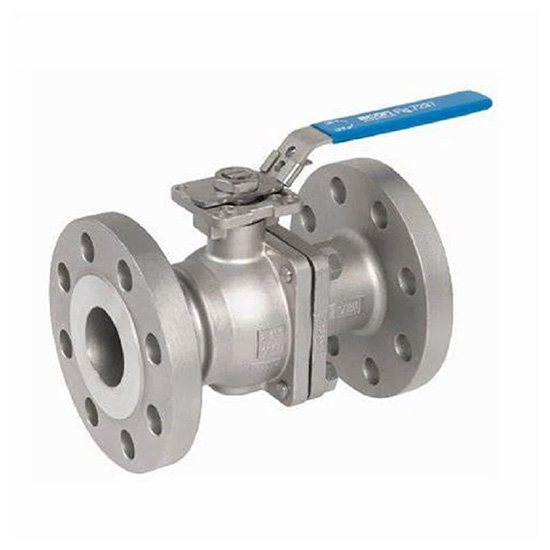
For ball-valve services in contact with seawater, our duplex-grade floating ball valves (F51/F53 trim) and forged trunnion-mounted ball valves (up to 48″, ANSI 150–1500) give you fire-safe, double-block-and-bleed performance rated for offshore and coastal duty. If you want the full alloy deep-dive, see our guide to duplex vs. super duplex stainless steel.
Send us your line list and media table — we’ll return a duplex vs. super-duplex recommendation with PREN, NACE compliance, and lead time.
| Criterion | Cast Steel (A216 / A351) | Duplex (2205 / F51) | Super Duplex (2507 / F53) |
|---|---|---|---|
| Typical PREN | ~10–12 (carbon) / ~25 (CF8M) | 34–35 | 42–43 |
| Min. yield strength | ~250 MPa (WCB) | 450 MPa | 550 MPa |
| Best streams | Pre-treatment, permeate, utility, low-Cl loops | Seawater intake, HP RO feed, ERD, brine | Highest chloride / temperature brine, offshore |
| Pressure range | Up to ANSI 1500lb+ | Up to ANSI 2500lb (forged) | Up to ANSI 2500lb |
| Relative cost | $ (lowest) | $$ | $$$ |
| Key standards | API 600 / 6D, A216, A351 | A182 F51, A351 CD3MN, NACE MR0175 | A182 F53, A351 CE3MN |
Rule of thumb: Put cast steel where chloride is low and pressure is high. Put duplex where chloride is high. Reach for super duplex only where temperature and concentration push 2205 to its limit.
You should map every line on your P&ID to its worst-case chemistry, not its average. A simple working framework:
Our water treatment and desalination valve applications page walks through typical configurations across the full train.
A valve that fails in year three costs you far more than its purchase price: lost production, emergency shutdown, divers or RO cleaning, and rework of welded joints. When you specify duplex in the right place, you are buying decades of service — not just a lower invoice. For EPC and plant owners, total cost of ownership (TCO), not the CAPEX line-item price, should drive the spec.
TCO lens: Purchase plus installation is typically only 15–25% of a valve’s 20-year cost. The rest is downtime, maintenance, and replacement — and material choice moves the big number.
Full-Think Valve (FTK) has manufactured industrial valves in China since 2012 and is an ISO 9001-certified supplier serving oil & gas, petrochemical, power, and water-treatment projects worldwide. We stock a broad material range — carbon steel, stainless, and duplex (F51/F53) — and supply valves with full material certificates, API 598 / API 6D test reports, and NACE-compliant options. Because we control forging, machining, and testing in-house, you get shorter lead times and a single point of accountability from quote to commissioning.
Send your P&ID, line list, or media table to Full-Think. We’ll return a cast-steel / duplex material recommendation with standards, lead time, and a spec-ready quote.
These go beyond the main guide — the practical questions we hear most from EPCs and plant engineers.
At minimum, require valves built and tested to the relevant API/ISO standards for the type (for example, API 6D for pipeline ball valves, API 600 for gate valves, API 607 for fire-safe, and API 598 for pressure testing). For the metals, ask for ASTM material certs (mill test reports), EN 10204 3.1/3.2, and NACE MR0175 / ISO 15156 compliance where sour or high-chloride service applies. For exports to Europe, PED 2014/68/EU marking matters; for quality systems, ISO 9001 (and API Q1 for higher-tier suppliers) is the baseline. Full-Think supplies these certificates as standard.
Start with CAPEX (purchase + freight + installation/welding), then add the big drivers: unplanned-downtime cost per hour of lost production, planned-maintenance labor, spare-part holding, and expected replacement cycles. In chloride service, a valve that lasts 20 years instead of 5 changes TCO far more than any unit-price difference. Model at least a 20-year horizon and sensitivity-test the “years-to-failure” assumption for each alloy choice.
For pressurized process lines, cast steel (A216 WCB/WCC) outperforms ductile iron on pressure rating and temperature, while bronze is generally limited to small, low-pressure, non-aggressive services. In high-chloride streams, none of the three beats duplex — so use cast steel, iron, or bronze only where chloride is genuinely low (permeate, utility, instrument loops), and reserve duplex for any seawater contact.
The top culprits are chloride pitting and crevice corrosion (wrong alloy in seawater/brine), erosion-corrosion at high-velocity RO feed, galvanic corrosion at dissimilar-metal joints, and seat/stem leakage from abrasive silica or debris. Mitigations include correct alloy selection (duplex where needed), controlled flow velocity, dielectric isolation at mixed-metal joints, and specified pressure and seat-leak testing per API 598.
Both raise corrosion risk. As you move from intake seawater toward concentrated brine reject, chloride concentration — and often temperature — climbs, pushing PREN requirements up. 2205 duplex is typically fine for ambient-temperature seawater; once you combine high temperature with high concentration (common in MSF brine and some RO reject), super duplex 2507 is the safer specification. Always design for the worst-case stream condition, not the average.
It depends on project control. A lump-sum valve package from one supplier (such as Full-Think) simplifies procurement, certification, and warranty, and usually improves lead-time coordination. Per-line specification gives maximum control where you have in-house valve expertise but multiplies purchase orders, certificates, and interface risk. A hybrid is common: standardize families (for example, all duplex ball valves from one source) while specifying critical lines individually.
Fire-safe certification (API 607 / API 6FA) is most critical where hydrocarbons are present — typically not in the water train itself, but relevant for associated fuel-gas, instrument-air, or chemical-dosing systems nearby. For the seawater/brine side, fire-safe is rarely mandated, but API 598 pressure testing and correct material certs always are. Specify fire-safe only where the risk assessment calls for it, to avoid paying for unused scope.
Helpful next reads from Full-Think:
(All images are sourced from the internet. In the event of any copyright infringement, please contact us and we will remove the content promptly.)