


In desalination plants and marine installations, the valve body is the first line of defense between aggressive seawater or brine and the process pipeline. Unlike piping — where a leak can be isolated and repaired — a valve body failure often means an uncontrolled shutdown, product contamination, or safety hazard.
The stakes are especially high in:
Selecting the right valve body material — duplex stainless steel (2205 / F51) or super duplex stainless steel (2507 / F53) — directly determines whether a valve survives pitting corrosion, crevice attack, or stress corrosion cracking (SCC) in these environments. This guide explains the technical differences, ASTM specifications, and selection criteria from a valve engineer’s perspective — not a general material comparison.
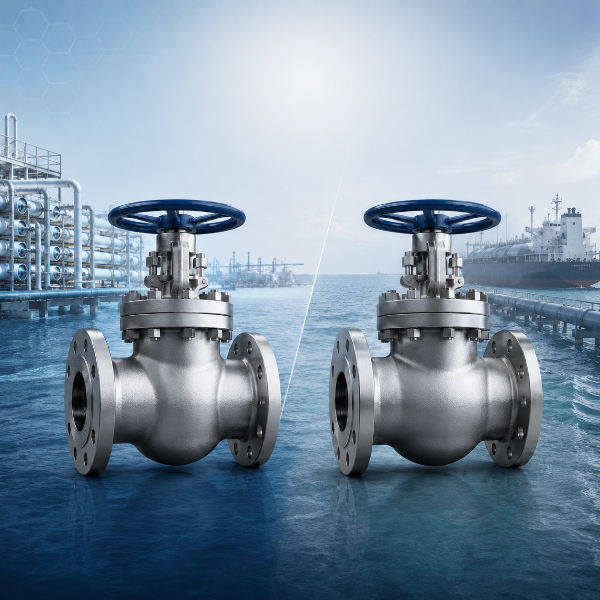 What Is Duplex Stainless Steel? (2205 / S32205 / F51)
Duplex stainless steel has a mixed microstructure of approximately 50% austenite and 50% ferrite — giving it the toughness of austenitic grades (like 316L) combined with the strength and stress corrosion cracking resistance of ferritic grades.
Standard Duplex Grade for Valve Bodies:
Duplex 2205 resists pitting corrosion in chloride environments up to approximately 1,000 ppm at moderate temperatures. This makes it suitable for:
Its yield strength of 450 MPa — roughly double that of 316L (205 MPa) — allows engineers to reduce wall thickness in pressure-containing valve bodies, partially offsetting the higher alloy cost.
Super duplex stainless steel builds on the duplex concept with significantly higher alloying content — particularly chromium (24–26%), molybdenum (3.5–4.2%), and nitrogen (0.24–0.32%). The result is a PREN ≥40, qualifying it for direct seawater service and the most aggressive chloride environments.
Super Duplex Grades for Valve Bodies:
Super duplex grades are the default specification for:
The 550 MPa yield strength — higher than duplex and nearly 3× that of 316L — enables even thinner valve body walls for high-pressure designs, reducing both weight and total material cost despite the per-ton premium.
The Pitting Resistance Equivalent Number (PREN) is the single most important indicator for chloride-service valve body selection. The formula is:
| Element | 316L (S31603) | Duplex S32205 | Super Duplex S32750 | Super Duplex S32760 |
|---|---|---|---|---|
| Chromium (Cr) | 16–18% | 21–23% | 24–26% | 24–26% |
| Nickel (Ni) | 10–14% | 4.5–6.5% | 6–8% | 6–8% |
| Molybdenum (Mo) | 2–3% | 2.5–3.5% | 3.5–4.2% | 3–4% |
| Nitrogen (N) | 0.03–0.10% | 0.10–0.22% | 0.24–0.32% | 0.20–0.30% |
| Tungsten (W) | — | — | — | 0.5–1.0% |
| Copper (Cu) | — | — | — | 0.5–1.0% |
| PREN (min) | ~25 | ≥34 | ≥41 (typ. 42–43) | ≥40 |
For valve body design under ASME B16.34, yield strength determines minimum wall thickness. Higher yield strength means thinner walls — which reduces both weight and raw material cost, partially offsetting the per-ton alloy premium.
| Property | 316L (CF8M) | Duplex (F51 / CD3MN) | Super Duplex (F53 / CE3MN) |
|---|---|---|---|
| 0.2% Yield Strength (min) | 205 MPa | 450 MPa | 550 MPa |
| Tensile Strength (min) | 515 MPa | 620 MPa | 795 MPa |
| Elongation (min) | 40% | 25% | 15% |
| Hardness (max HBW) | — | 290 | 310 |
| Yield vs. 316L | Baseline | ≈ 2.2× | ≈ 2.7× |
For valve bodies in chloride environments, three corrosion mechanisms dominate:
Pitting creates small, deep holes that can penetrate a valve body wall with minimal overall mass loss — making it the most dangerous form for pressure-containing components. PREN is the primary indicator: PREN ≥40 is required for seawater-rated resistance.
Crevice corrosion occurs under gasket surfaces, flange faces, and valve body-to-bonnet joints — exactly where valve assemblies have multiple crevice geometries. CCT (Critical Crevice Temperature) values are typically 10–15°C lower than CPT for the same grade.
SCC is the sudden, brittle failure under tensile stress plus chloride exposure — the mechanism that makes 316L valve bodies crack in warm seawater. Both duplex and super duplex offer far superior SCC resistance compared to austenitic grades.
Most duplex vs super duplex articles discuss UNS numbers and EN designations for piping. For valve bodies, the relevant ASTM specifications are different — and understanding the distinction between forged and cast grades is critical.
| Material | UNS | Forged Grade (ASTM A182) | Cast Grade (ASTM A351) | Typical Valve Application |
|---|---|---|---|---|
| Duplex 2205 | S32205 | F51 | CD3MN | Small forged ball valves, flanges, fittings |
| Super Duplex 2507 | S32750 | F53 | CE3MN | Forged trunnion ball valves, high-pressure bodies |
| Super Duplex Zeron 100 | S32760 | F55 | CD4MCu | Marine/chemical mixed-environment valve bodies |
⚠️ Forged vs. Cast — Why It Matters for Valve Bodies:
Desalination plants present a gradient of chloride aggressiveness — from intake seawater (~19,500 ppm) through pretreatment to concentrated brine reject (~35,000+ ppm). Valve material requirements change accordingly.
| Process Zone | Chloride Level | Pressure | Recommended Valve Body | Common Valve Types |
|---|---|---|---|---|
| Intake / Low-Pressure Pretreatment | ~19,500 ppm (seawater) | Low (2–6 bar) | Super Duplex F53 | Butterfly valve, gate valve |
| RO High-Pressure Feed | ~19,500 ppm | High (60–80 bar) | Super Duplex F53 | Trunnion ball valve, check valve |
| Brine Reject / Concentrate | ~35,000+ ppm | Medium (4–8 bar) | Super Duplex F53/F55 | Ball valve, gate valve |
| Product Water / Permeate | ~200 ppm | Low | 316L or Duplex F51 | Butterfly valve, globe valve |
| Process Cooling / Brackish | ~1,000 ppm | Variable | Duplex F51 | Floating ball valve, check valve |
Marine and offshore valve service adds several demands beyond pure chloride corrosion:
Use this decision table to quickly identify the right valve body grade for your service environment:
| Service Environment | Chloride | Temp | Sour? | Recommended Grade | ASTM Forging | FTK Product |
|---|---|---|---|---|---|---|
| Fresh water / product water | <200 ppm | ≤50°C | No | 316L (F316/CF8M) | A182 F316 | SS 316 Check Valve |
| Brackish / process cooling | ~1,000 ppm | ≤50°C | No | Duplex 2205 | A182 F51 | Forged Floating Ball Valve |
| Seawater (static/low flow) | ~19,500 ppm | ≤25°C | No | Super Duplex 2507 | A182 F53 | Forged Trunnion Ball Valve |
| Seawater (warm / flowing) | ~19,500 ppm | 25–60°C | No | Super Duplex 2507 | A182 F53 | Ball Valve Range |
| Desalination brine reject | ~35,000+ ppm | ≤60°C | No | Super Duplex 2507 / Zeron | F53 / F55 | Forged Ball Valve (F53) |
| Sour seawater (H₂S + Cl⁻) | ~19,500 ppm | Variable | Yes | Super Duplex S32760 | A182 F55 | Ball Valve Range |
| High-pressure RO feed (desal) | ~19,500 ppm | ≤60°C | No | Super Duplex 2507 | A182 F53 | Forged Trunnion (F53) |
For valve bodies in oil & gas environments containing H₂S, NACE MR0175 / ISO 15156 compliance is mandatory. Both duplex and super duplex are accepted — but with different limits:
| Grade | NACE MR0175 Part | H₂S Limit | Key Condition |
|---|---|---|---|
| Duplex S32205 (F51) | Part 2 | Lower H₂S partial pressures | Max hardness 28 HRC; solution annealed condition only |
| Super Duplex S32750 (F53) | Part 2 / Part 3 | Higher H₂S partial pressures | May qualify as CRA under Part 3 for most aggressive conditions |
| Super Duplex S32760 (F55) | Part 2 / Part 3 | Higher H₂S partial pressures | Tungsten + copper additions improve mixed acid + sour resistance |
Valve body fabrication — whether forging, machining, or welding — differs significantly between duplex and super duplex:
⚠️ Critical Warning: Both duplex and super duplex can form σ-phase (sigma phase) — a brittle intermetallic compound — if held in the 700–980°C range during processing. Sigma phase formation destroys both corrosion resistance and toughness. For valve bodies:
FTK Valve offers both Duplex F51 and Super Duplex F53 as body material options across its forged ball valve range. Below are the key products available with these material grades:
The primary choice for small-to-medium size desalination and marine isolation valves, with both Duplex F51 and Super Duplex F53 listed as standard body material options.
| Size Range | 1/2″ ~ 4″ (DN15 – DN100) |
| Pressure Rating | ANSI 800lb ~ 2500lb; 1000 WOG ~ 3000 WOG |
| Body Materials | Carbon steel (A105, LF2), Stainless steel (F304, F316, F321, F51, F53) |
| Design Standard | BS 5351 |
| Test Standard | API 598, BS 6755, API 607 (Fire Safe) |
| Seat Options | PTFE, RPTFE, TFM1600, DEVLON, MOLON, Metal/Metal, NYLON, PEEK, VITON |
| Key Features | Fire safe, blowout-proof stem, anti-static, low emission, ISO 5211 top flange |
The preferred valve for high-pressure desalination RO feed lines and offshore subsea isolation. F51 listed in trim; F53 and INCONEL 625/825/718 available in alloy body options.
| Size Range | 2″ ~ 48″ |
| Pressure Rating | ANSI 150lb ~ 1500lb |
| Body Materials | Carbon steel, Stainless steel, Alloy (F51, INCONEL 625/825/718) |
| Design Standard | API 6D |
| Test Standard | API 6D, BS 6755, API 607, API 6FA |
| Key Features | DBB, emergency sealant injection, cavity relief, fire safe |
European-standard short pattern design for DN15–DN200, PN 16–40. F51 and F53 available as trim material for desalination pretreatment and chemical service.
FTK offers 7 check valve types for pipeline infrastructure — several with stainless and alloy body options suitable for desalination and marine applications:
| API 6D Pipeline Swing Check Valve | Pipeline + optional dashpot for water hammer |
| Dual Plate Check Valve | Compact fast-close, API 594/6D |
| SS 316 Swing Check Valve | API 603, chemical/food/low-temp service |
| BS 1868 Swing Check Valve | General industrial, large inventory |
| API 603 Stainless Steel Gate Valve | Stainless isolation for chemical/low-chloride lines |
| Bellow Sealed Gate Valve | Zero-emission isolation for hazardous marine fluids |
| Trunnion Mounted Ball Valve Category | Full range including top entry, forged, API 6D pipeline |
| Gate Valve Category | Full range including rising stem, NRS, parallel slide, pressure seal |
PREN ≥40 is the recognized threshold for seawater-rated valve bodies. Duplex 2205 at PREN ≥34 falls below this and is suitable only for brackish water (≤1,000 ppm chloride). Super Duplex 2507 at PREN ≥42 exceeds the threshold comfortably. View FTK Super Duplex (F53) ball valve options →
No. Duplex 2205 (PREN ≥34) is limited to approximately 1,000 ppm chloride at moderate temperatures. Direct seawater (~19,500 ppm) and desalination brine (~35,000+ ppm) require super duplex F53 or F55 with PREN ≥40. Explore FTK F53 trunnion ball valve →
F51 = ASTM A182 UNS S31803/S32205 (Duplex 2205 forged). F53 = ASTM A182 UNS S32750 (Super Duplex 2507 forged). F55 = ASTM A182 UNS S32760 (Zeron 100 forged). Cast equivalents are A351 CD3MN, CE3MN, and CD4MCu respectively. Always specify the ASTM grade, not just “duplex” or “2507.” See ASTM A182 F51/F53 on FTK forged valves →
Yes. Super duplex costs 30–40% more per valve initially, but in seawater/brine service, 316L or duplex bodies typically fail within 5–10 years from pitting or SCC. A super duplex F53 body in the same service lasts 20–30 years — making the lifecycle cost 3–5× lower. Request FTK desalination valve quote →
Both grades are rated to approximately 300°C maximum service temperature. However, prolonged exposure above 250°C risks σ-phase embrittlement. For valve bodies in hot service, verify that the solution anneal + quench condition is maintained. Check FTK high-pressure valve options →
Yes. S32205 (F51) is accepted under Part 2 with limits on H₂S partial pressure and max hardness 28 HRC. S32750 (F53) and S32760 (F55) are qualified under Part 2 and may be accepted under Part 3 as CRAs for higher H₂S conditions. View NACE-compliant FTK valve options →
Yes, with controlled procedures. Duplex 2205 welds with 2209 filler at 0.5–2.5 kJ/mm heat input. Super duplex 2507 requires 2594 filler and stricter heat control (≤1.5 kJ/mm). No post-weld heat treatment is used — process control is the only quality assurance. Contact FTK engineering support →
Forged floating ball valves, trunnion mounted ball valves, check valves, gate valves, and globe valves — especially in small forged sizes (≤4″ floating, ≤48″ trunnion) where ASTM A182 F51/F53 are standard body options.
Duplex F51: 450 MPa minimum (≈2.2× 316L). Super Duplex F53: 550 MPa minimum (≈2.7× 316L). Higher yield enables thinner valve body walls under ASME B16.34, partially offsetting the alloy cost premium. Compare F51 vs F53 specs on FTK valves →
Require EN 10204 3.1 MTC (minimum) or 3.2 for offshore projects, confirming chemistry, mechanical properties, and heat traceability. Perform PMI (Positive Material Identification) testing on the valve body and ferrite measurement (ASTM E562) to confirm 35–55% (duplex) or 40–50% (super duplex) ferrite content. Request FTK material certificates →
Choosing between duplex and super duplex for a valve body in desalination or marine service is not a matter of “better or worse” — it is about matching the material’s corrosion resistance, mechanical strength, and compliance profile to the specific service environment.
FTK Valve provides both F51 and F53 body material options on its forged ball valve range, backed by API 598 / API 6D testing compliance and fire-safe certification. For desalination and marine projects requiring seawater-rated valve bodies, contact our engineering team for grade-specific specifications and material test certificates.
FTK Valve offers F51 (Duplex 2205) and F53 (Super Duplex 2507) body material options with API 598 / API 6D compliance, fire-safe certification, and full EN 10204 3.1 material test certificates.
Published by FTK Valve (FULL-THINK VALVE CO., LTD) | ISO-certified industrial valve manufacturer | API 6D, API 600, API 602, API 603 compliant
This article is for educational purposes. Always consult project-specific material specifications and qualified metallurgical engineers for critical service valve selection.
 Optimized by Seraphinite Accelerator