

Water hammer — also known as hydraulic shock or pressure surge — is a sudden spike in pipeline pressure caused by a rapid change in fluid velocity. When flow stops abruptly or reverses direction, the kinetic energy of the moving fluid converts into a pressure wave that travels through the pipe at the speed of sound in that medium.
In pumped pipeline systems, this phenomenon occurs most frequently at pump shutdown. When the pump stops, fluid continues moving forward by inertia, then gradually reverses direction. The non-return valve (check valve) installed downstream of the pump is designed to prevent this reverse flow — but how it closes determines whether water hammer occurs or is avoided.
The pressure surge from water hammer can amplify normal system pressures by up to 10 times or more, even though the event may last only milliseconds. This transient overpressure far exceeds the design limits of most pipeline components.
⚠ Critical Insight
Water hammer is not limited to water systems. The same surge phenomenon occurs in oil, gas, steam, and chemical pipelines — any system where fluid momentum changes rapidly. The severity depends on fluid density, pipeline length, and how quickly the flow velocity changes.
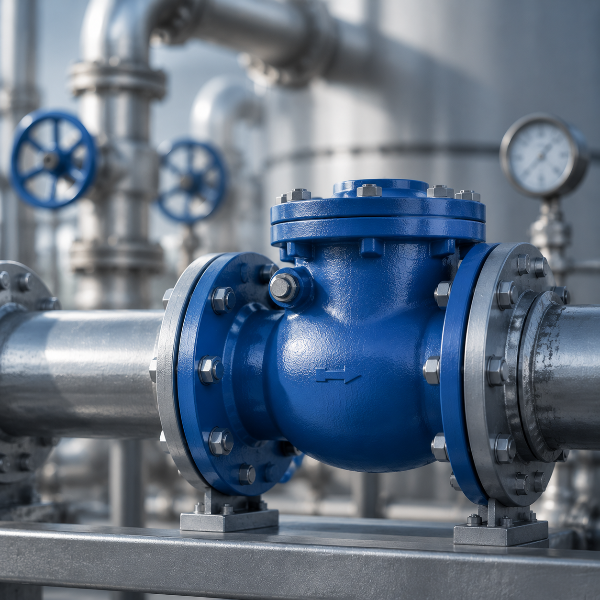
(All images are sourced from the internet. In the event of any copyright infringement, please contact us and we will remove the content promptly.)
The consequences of unchecked water hammer extend far beyond a noisy pipe. Repeated pressure surges cause progressive damage that compounds over time:
| Damage Type | Mechanism | Impact |
|---|---|---|
| Pipe burst | Transient pressure exceeds pipe wall design limit | Catastrophic failure, flooding, safety hazard |
| Flange/gasket leakage | Joint separation under surge pressure | Product loss, environmental contamination |
| Pump damage | Reverse spin from unchecked backflow | Bearing failure, motor burnout, downtime |
| Valve seat wear | Repeated disc slamming erodes sealing surfaces | Accelerated leakage, shorter valve life |
| Instrument failure | Pressure transducers and flow meters hit by surge | False readings, control system errors |
In high-pressure oil and gas pipelines, water hammer can compromise API 6D pipeline valve integrity. In steam power plants, surge events can damage pressure seal bonnet check valves designed for 900–2500 lb service. The cost of a single burst event — including emergency repair, product loss, environmental cleanup, and regulatory penalties — often exceeds the cost of proper water hammer prevention by orders of magnitude.
Not all water hammer originates from pump startup or shutdown. One of the most common — and most overlooked — causes is check valve slam.
Check valve slam occurs when the valve disc is open during forward flow, then snaps shut the moment reverse flow begins. The disc accelerates under reverse-flow pressure and impacts the valve seat with significant kinetic energy. This impact creates two problems simultaneously:
The severity of slam depends on the disc’s travel distance, the reverse flow velocity when the disc closes, and the disc’s mass. Large-diameter swing check valves are particularly susceptible because their discs swing through a wide arc (typically 60–70°) and have substantial mass. When a 24-inch swing disc slams shut, the resulting pressure surge can be devastating.
This is precisely why FTK’s API 6D Pipeline Swing Check Valve offers an optional dashpot (hydraulic damper) device — to control the disc closing time and eliminate slam in large pipeline applications.
📌 Key Principle
To prevent check valve slam, the valve must either close before reverse flow begins (fast closure strategy) or close slowly and softly after reverse flow starts (damper strategy). A valve that closes in the middle — catching reverse flow at moderate velocity — produces the worst slam conditions.
Engineering practice recognizes two fundamentally different approaches to preventing slam-induced water hammer. Understanding both strategies is essential for selecting the right non-return valve for your pipeline.
If the valve disc reaches its seat before the fluid reverses direction, there is no reverse flow to slam the disc, and no sudden flow stoppage to create a pressure wave. This requires a valve with:
This strategy is best implemented by spring-loaded dual plate check valves and tilting disc check valves, where the disc travels only a few degrees and a spring provides proactive closing force. FTK’s Dual Plate Check Valve (API 594/6D) uses this principle: two spring-loaded plates close rapidly with minimal travel distance, preventing reverse flow from ever developing significant momentum.
When rapid closure is impractical — for example, in large-diameter pipelines where disc mass and travel distance are significant — the alternative is to allow reverse flow to develop but slow the disc’s closing speed so it seats gently rather than slamming.
A dashpot (hydraulic damper) absorbs the disc’s kinetic energy during closure, extending the closing time from milliseconds to a controlled, predictable duration. The reverse flow that passes through the valve during this extended closure is managed by ensuring the upstream pump can tolerate brief reverse spin and flow.
This strategy is best suited for large swing check valves in long pipeline systems where rapid closure would be mechanically impractical. FTK’s API 6D Pipeline Swing Check Valve incorporates this approach: for big sizes, a dashpot device can be assembled to control the disc closing time, preventing potential water hammer damage caused by disc closing.
| Comparison | Strategy A: Fast Close | Strategy B: Dashpot Close |
|---|---|---|
| Closing speed | Very fast (<0.5s) | Slow, controlled (1–5s) |
| Reverse flow | Prevented (disc closes first) | Allowed briefly (pump must tolerate) |
| Pressure surge | Minimal (no sudden stoppage) | Minimal (soft, cushioned seating) |
| Best valve type | Spring-loaded dual plate / tilting disc | Swing check with dashpot |
| Best pipeline size | 2″–36″ compact installations | 12″–48″ long-distance pipelines |
| FTK product | Dual Plate Check Valve | API 6D Swing Check Valve |
Different check valve designs have inherently different closing characteristics. Selecting the right type for water hammer prevention requires understanding how each design behaves during pump shutdown and flow reversal.
The swing check valve is the most widely used non-return valve in pipeline systems. Its disc (or “door”) swings on a hinge pin from fully open to fully closed, traveling through an arc of 60–70°. This long travel distance and the disc’s substantial mass make swing check valves inherently prone to slam, especially in large sizes.
However, swing check valves offer important advantages for full-bore pipeline applications: they provide unobstructed flow when open (essential for pigging operations in oil & gas pipelines), and they are available in sizes up to 48″ with a wide range of pressure ratings.
The slam risk can be eliminated by adding a dashpot (hydraulic damper), which controls the disc’s closing speed. This transforms a slam-prone valve into a water hammer-safe solution — exactly the approach FTK takes with its API 6D Pipeline Swing Check Valve.
FTK offers three swing check valve variants for different applications:
The dual plate check valve (also called butterfly check valve or dual disc check valve) uses two spring-loaded plates mounted on a central hinge pin. When flow stops, the springs immediately push the plates toward the closed position — before reverse flow can develop significant momentum.
Key advantages for water hammer prevention:
FTK’s Dual Plate Check Valve (API 594/6D) is available in sizes from NPS 2″ to 36″ with ratings from ANSI 150lb to 900lb. It offers spring-loaded plates for slam prevention, optional piston-type spring-loaded disc or swing-type disc, and multiple end connections (flange, wafer, lug).
The lift piston check valve uses a piston that moves vertically (or along the flow axis) inside a guide cylinder. Flow lifts the piston off its seat; when flow stops, gravity and/or spring force pushes the piston back down.
Lift piston valves offer guided, linear closure — the piston travels in a controlled path with no swing arc. This makes them less prone to slam than unguided swing discs, though their closing speed depends on flow conditions and whether a spring is included.
FTK’s DIN EN Lift Piston Check Valve (EN 13709) provides European-standard lift piston design for industrial applications requiring precise, guided closure. Available with EN 1092-1 flanged ends and tested per EN 12266/ISO 5208.
In power generation — nuclear and fossil fuel plants — steam systems operate at extreme temperatures and pressures (Class 900–2500). These conditions amplify water hammer severity because high-pressure steam carries enormous kinetic energy.
Pressure seal bonnet (PSB) valves use the system’s own pressure to tighten the bonnet seal, providing exceptional leak-tightness at high pressures with simpler construction than bolted bonnet designs. When equipped with appropriate closing mechanisms, they can serve in water hammer-prone steam applications.
FTK’s Pressure Seal Bonnet PSB Check Valve (BS 1868/API 6D/ASME B16.34) is designed for high-temperature, high-pressure services in nuclear and fossil fuel power plants, offering absolute excellent seal service with minimum maintenance.
For small-diameter high-pressure systems (NPS ½” to 2″), forged steel check valves offer superior structural integrity versus cast bodies. These compact valves are common in refinery and petrochemical branch lines where water hammer can still occur despite the small pipe diameter.
FTK’s Bolted Cover Forged Check Valve (API 602/BS 5352) provides forged steel reliability with standard bolted bonnet and optional welded bonnet, including bellow seal options for zero-leakage requirements.
Use this decision table to quickly identify which FTK check valve type best suits your pipeline’s water hammer risk profile:
| Pipeline Condition | Slam Risk | Recommended Valve | Key Advantage |
|---|---|---|---|
| Large pipeline (12″–48″), pigging required | High (long disc travel, high mass) | API 6D Swing Check + Dashpot | Dashpot controls closing time; full bore for pigging |
| Medium pipeline (2″–36″), compact installation | Moderate–Low | Dual Plate Check Valve | Spring-loaded fast close; compact wafer/lug body |
| General industrial (2″–48″), standard service | Moderate | BS 1868 Swing Check Valve | Wide range, large stock, quick delivery |
| Steam/power plant (Class 900–2500) | Very High | Pressure Seal PSB Check Valve | High-temp/HP design; pressure-actuated seal |
| Chemical/food/cryogenic (SS 316) | Moderate | SS 316 Swing Check Valve | Corrosion-resistant; API 603 lightweight |
| European standard (EN), lift/piston design | Moderate–Low | DIN EN Lift Piston Check Valve | Guided linear closure; EN 13709 compliant |
| Small bore high-pressure (½”–2″) | Moderate | Forged Steel Check Valve | Forged integrity; API 602/BS 5352; bellows option |
FTK Valve (FULL-THINK VALVE Co., Ltd) offers seven distinct check valve product lines covering every major pipeline application — from compact dual plate valves for fast-closing slam prevention to large API 6D swing checks with dashpot dampers for pipeline-scale water hammer control.
The Definitive Pipeline Water Hammer Solution
FTK’s API 6D Pipeline Swing Check Valve is specifically engineered for long-distance oil and gas pipelines where water hammer risk is highest. Key water hammer prevention features:
Design Standards: API 6D | ASME B16.10 | ASME B16.5/B16.47/MSS SP44/B16.25 | Test: API 598/BS 6755
The Compact Slam-Prevention Solution
FTK’s Dual Plate Check Valve (API 594/6D) prevents slam through rapid spring-assisted closure — the plates close before reverse flow can develop momentum:
Design Standards: API 594/6D | ASME B16.10/EN558-1 | ASME B16.5/EN1092 | Test: API 598/EN12266
| Product | Standard | Best Application | Water Hammer Feature |
|---|---|---|---|
| API 6D Pipeline Swing | API 6D | Oil & gas pipeline | Optional dashpot for slam control |
| Dual Plate Check | API 594/6D | Compact, fast-close | Spring-loaded fast closure |
| BS 1868 Swing Check | BS 1868 | General industrial | Wide range; can add dashpot |
| PSB Pressure Seal | BS 1868/API 6D/B16.34 | Nuclear/fossil power | High-pressure seal integrity |
| SS 316 Swing Check | API 603 | Chemical/food/cryogenic | Lightweight; corrosion-proof |
| DIN EN Lift Piston | EN 13709 | European industrial | Guided linear closure |
| Forged Steel Check | API 602/BS 5352 | Small bore high-pressure | Forged integrity; bellows option |
Explore All FTK Check Valves →
In some pipeline systems, a properly selected non-return valve cannot fully eliminate water hammer risk by itself. Conditions that may require additional surge protection include:
In these cases, supplementary measures complement the check valve:
The key principle: water hammer prevention is a system-level concern, not a single-component solution. The non-return valve is the primary defense, but the correct number, types, and sizes of air valves, the closing and opening times of isolation valves, and the pump’s operating characteristics all contribute to a surge-safe system.
Check valves are one of the least understood valve types, and their importance in water hammer prevention is regularly overlooked. These common mistakes lead to operational problems, premature failure, and ongoing surge damage:
Many specifiers choose check valves based solely on nominal pipe size and pressure class, ignoring closing speed and hydraulic characteristics. A valve that fits the pipe and withstands the pressure may still slam violently if its closing behavior doesn’t match the system’s flow dynamics. Always evaluate the valve’s closing time, disc travel distance, and available damping options.
An oversized check valve operates with the disc partially open during normal flow, creating turbulence and instability. When the pump stops, the disc must close from a partially open position with more travel remaining — increasing slam severity. Correct sizing ensures the disc is fully open during normal flow and has predictable closing behavior.
When using a dashpot-equipped valve (Strategy B), reverse flow passes through the valve during the controlled closing period. The upstream pump must tolerate this brief reverse spin and flow. If the pump cannot accept reverse rotation, a fast-closing valve (Strategy A) must be used instead, regardless of pipeline size.
A check valve prevents reverse flow — but how it prevents reverse flow determines whether water hammer occurs. An un-damped swing check valve in a large pipeline will slam shut and cause water hammer, not prevent it. The valve type and closing mechanism must be selected for the specific system’s surge characteristics.
Check valves must be installed in the correct orientation for their design. Swing check valves require horizontal pipe with the hinge pin on top; vertical-up installations need lift/piston or spring-loaded designs. Wrong orientation can cause the disc to hang open or slam with greater force.
Water hammer is a sudden pressure surge caused by rapid flow velocity change — typically when flow stops or reverses at pump shutdown. The kinetic energy of moving fluid converts into a pressure wave that can amplify normal pressures 10×. FTK check valves with appropriate closing strategies prevent slam-induced surges.
Yes. When a check valve disc slams shut on reverse flow, it creates both a localized pressure spike and a sudden flow stoppage — two simultaneous surge generators. This is called check valve slam. FTK’s API 6D Pipeline Swing Check Valve with dashpot eliminates slam by controlling disc closing speed.
It depends on your system. For large pipelines (12″–48″) where pigging is required, a swing check valve with dashpot provides controlled soft closure. For compact installations (2″–36″), a spring-loaded dual plate check valve closes before reverse flow develops.
A dashpot is a hydraulic damper device attached to the swing check valve disc hinge. It absorbs kinetic energy during disc closure, extending closing time from milliseconds to a controlled duration (1–5 seconds), preventing slam. FTK’s API 6D Pipeline Swing Check Valve offers this as an optional feature for big-size applications.
Two valid approaches: close very fast (under 0.5 seconds, before reverse flow begins — dual plate/spring-loaded design) or close very slowly (1–5 seconds with dashpot after reverse flow starts). The worst scenario is moderate-speed closure that catches reverse flow at peak velocity. Compare both strategies in FTK’s check valve range.
Swing check valves have a single disc on a hinge with long travel (60–70°) — prone to slam unless equipped with a dashpot. Dual plate valves use two spring-loaded plates with short travel (35–45°) — they close rapidly before reverse flow develops. Swing checks suit large full-bore pipelines; dual plates suit compact installations.
API 6D addresses pipeline valve safety and performance. While it doesn’t mandate dashpots specifically, it requires valves to perform reliably under all operating conditions — including pump trip and surge events. FTK’s API 6D Pipeline Swing Check Valve offers dashpot as an option to meet this requirement. See our API 6D Standards blog for more.
Oil & gas pipelines (long-distance, high-pressure), power plants (steam systems at extreme temperature/pressure), petrochemical (chemical processing), and water treatment (pumped distribution systems). FTK serves all these industries with application-specific check valve solutions.
Consider flow velocity, pipe diameter, closing speed requirements, system pressure rating, and the pump’s reverse spin tolerance. Avoid oversizing — a correctly sized valve operates fully open during normal flow. Contact FTK’s engineering team for application-specific sizing guidance.
Surge tanks are needed in very long pipelines where pressure waves reflect multiple times, or in systems where even a dashpot-equipped valve cannot fully absorb the surge. For most industrial applications, a properly selected and damped check valve provides sufficient protection. FTK’s API 6D dashpot-equipped swing check handles the majority of pipeline surge scenarios.
Water hammer is not a minor inconvenience — it is a destructive force that can burst pipes, damage pumps, and create serious safety hazards. Check valve slam is one of the most common and preventable causes of pipeline water hammer, yet it remains one of the most frequently overlooked.
The solution is straightforward once the mechanism is understood: select a non-return valve that either closes before reverse flow begins (spring-loaded dual plate design) or closes slowly with a hydraulic dashpot (damper-equipped swing check design). Avoid the worst-case scenario — a valve that catches reverse flow at moderate velocity and slams shut.
FTK Valve offers seven check valve product lines covering every major pipeline scenario, with two hero products specifically engineered for water hammer prevention:
Selecting the right check valve for water hammer prevention is a system-level decision that requires understanding your pipeline’s flow dynamics, the pump’s reverse spin tolerance, and the available valve closing strategies. FTK’s engineering team can help you make the right choice — contact us for application-specific guidance.
Expand your knowledge with these FTK technical guides:
Stop Water Hammer Before It Stops Your Pipeline
FTK’s API 6D dashpot-equipped swing check valves and spring-loaded dual plate check valves are engineered to prevent slam-induced surges in oil & gas, petrochemical, power, and water treatment pipelines.
This article is for informational purposes only. Always consult with qualified pipeline engineers and valve manufacturers for project-specific selection and sizing. FTK Valve (FULL-THINK VALVE Co., Ltd) is an ISO 9001 certified manufacturer serving global oil & gas, petrochemical, power, and water treatment industries since 2012. Products comply with API 6D, API 594, API 602, API 603, BS 1868, BS 5352, EN 13709, ASME B16.10, ASME B16.5, ASME B16.34, and other applicable standards.