


When you plan a new liquefaction train, an import terminal, or a bunkering berth, the valve schedule is rarely the first item on the table — but it is one of the items that decides whether the asset performs the way the design promised. The global push toward flexible gas infrastructure has moved a large share of new valve demand into cryogenic service, and that shift changes how specifications are written, verified, and audited.
This article follows the chain from infrastructure investment to the specification line item, and shows where your selection discipline needs to tighten. It is written for project engineers, EPC package owners, and procurement teams who specify isolation and control elements for low-temperature gas service.
The number of liquefaction trains, floating storage regasification units, and small-scale peak-shaving facilities has grown well beyond the traditional base of onshore terminals. Each of these assets concentrates a demanding set of service conditions in a compact footprint: storage and transfer near -162°C, tight fugitive-emission limits, and reliability requirements that tolerate little downtime. As a result, the expansion of gas infrastructure programs has steadily increased the need for valves that can hold sealing and structural integrity at extreme low temperatures.
That pressure does not land equally on every valve in the package. It concentrates on the elements that sit in cryogenic lines, boil-off gas paths, and emergency isolation duty. For many teams, this is where trunnion mounted ball valves move from a default choice to a deliberately engineered one, specified around low-temperature seat behavior and actuator torque margins rather than catalog ratings alone.
The link between infrastructure spending and valve selection is not direct, but it is predictable. A new LNG program creates EPC packages; those packages create valve schedules; and those schedules force a set of acceptance criteria onto every supplier bid. When several programs run in parallel across coastal, offshore, and modular skid formats, the cumulative effect is a structural change in what “standard” means for a low-temperature valve.
Marine bunkering and floating production programs are a useful example. As shipbuilding and bunkering initiatives scale up, the requirement for compact, cryogenic-qualified shutoff solutions climbs in tandem — often inside tighter space and weight envelopes than onshore plants allow. Modular skid builders, meanwhile, compress what used to be a multi-week site integration into a single factory acceptance event, which raises the bar on documented testing before the valve ever reaches the site.
Room-temperature performance data does not travel into cryogenic duty. You should define minimum and transient temperatures, not only the normal operating point, and confirm that body, trim, seat, and packing materials are qualified for the low end of the range. Low-temperature toughness and stable sealing behavior at -162°C are the difference between a valve that commissions cleanly and one that leaks after the first cooldown.
| Service / medium | Typical temperature |
|---|---|
| LNG storage & transfer | -162°C |
| Liquid nitrogen (common test medium) | -196°C |
| Cryogenic qualification threshold | ≤ -50°C |
| Stem packing warm zone | +20°C to +120°C |
Methane-intensity targets now reach the valve stem. You will want low-emission packing, documented stem-seal performance, and — where the duty is critical — live-loading or bellows arrangements. These are no longer “nice to have” notes; they are frequently written into the project’s environmental acceptance criteria.
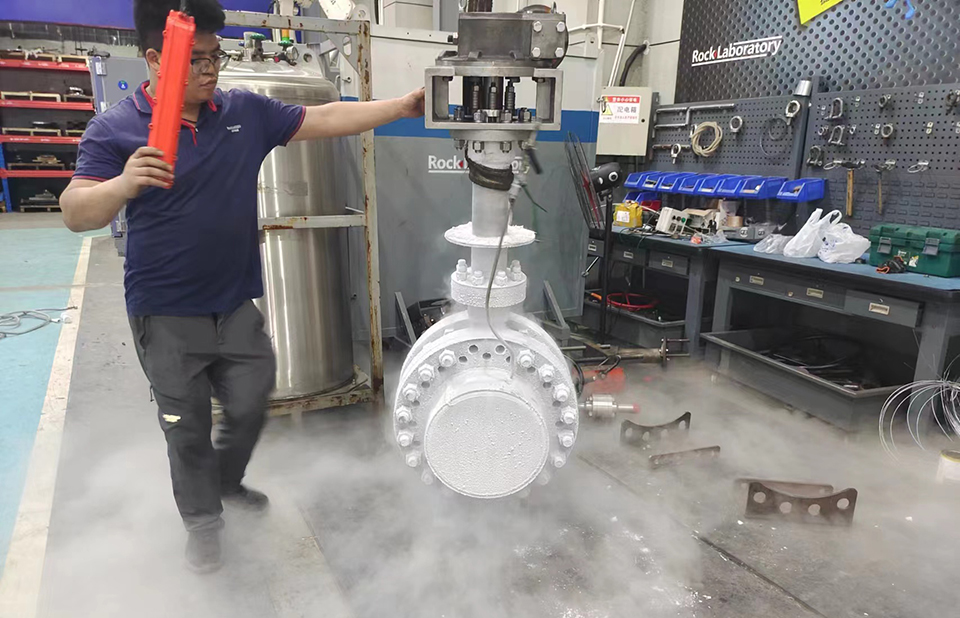
Confidence comes from evidence, not claims. A disciplined package asks for material test reports, cryogenic type-test records, non-destructive examination scope, and fire-safe certification. FULL-THINK Valve performs in-house cryogenic testing down to -196°C, which lets you verify low-temperature seat and torque behavior before the valve ships rather than after it is installed.
For low-temperature floating designs, floating ball valves engineered for cryogenic duty cover the -196°C to -46°C band and give you a cost-effective option for utilities and secondary isolation where a trunnion design is not required. When in-line maintainability matters, top entry ball valves let you service the seat and seals without removing the valve from the line.
If your next LNG or low-temperature gas package needs valves qualified against real -196°C test evidence, the FULL-THINK Valve engineering team can review your duty profile and recommend designs that hold up after the first cooldown.
Not every valve in an LNG package sees the same stress profile. The table below maps common valve types to the concerns that matter most in low-temperature gas service and the specification direction that follows.
| Valve type | Primary LNG concern | What you should specify |
|---|---|---|
| Trunnion ball valve | Tight shutoff, low-temperature seat behavior, torque margins | Cryogenic seat design, extended bonnet, fire-safe and emission packing |
| Floating ball valve | Utility and secondary isolation in the -196°C to -46°C band | Cryogenic-qualified body and seat, verified leakage class |
| Top entry ball valve | Maintainability without line removal | In-line service access, documented cryogenic test record |
| ESD / emergency valve | Fast, reliable fail-safe isolation | SIL alignment, actuator response, partial-stroke test compatibility |
For long-distance transfer and tie-in to transmission systems, API 6D pipeline ball valves give you a forged-body option built to pipeline acceptance criteria, with shorter lead times than equivalent cast designs.
A reliable specification package turns project risk into verifiable acceptance criteria. Before your next bid package is released, confirm the following:
If your program also touches hydrogen or other energy-transition media, the selection logic overlaps closely with what we cover in our hydrogen and energy-transition valve guidance. The underlying discipline — define the service, prove the material, verify the test — is the same.
Review forged and top-entry trunnion designs built to API 6D and fire-safe criteria, with documented cryogenic test records available on request. Shortlist the bodies and trim you need, then send us your schedule.
Cryogenic service is generally referenced at or below -50°C, and LNG is stored and transferred near -162°C. Testing standards such as BS 6364 define cryogenic type testing across the -196°C to +120°C band, so a valve qualified for LNG duty should carry evidence of behavior at the actual storage temperature, not just at the -50°C threshold.
The most relevant references are BS 6364 for cryogenic valves, API 6D for pipeline valves, ISO 28921 for cryogenic ball valves, API 607 and API 6FA for fire-safe performance, and ISO 15848 for fugitive-emission control. Your specification should name the applicable standard per duty rather than relying on a generic “cryogenic” note.
An extended bonnet moves the stem packing and gland away from the cold valve body into a warmer zone. This prevents ice bridging and stem freezing, keeps the packing within its working temperature range, and reduces heat leak into the cryogenic stream. It is one of the simplest and most effective adaptations for low-temperature duty.
Liquefaction plants emphasize high-pressure process isolation, frequent thermal cycling, and tight shutoff under continuous operation. Import and regasification terminals concentrate on sendout, boil-off gas handling, and lower-temperature swings with fewer high-cycle loops. The failure consequences differ, so the criticality ranking of valves in the schedule should differ too.
Look for documented cryogenic type-test records at -196°C, material test reports, defined NDE scope, fire-safe and emission certifications, and a track record in low-temperature gas service. Equally important is how the supplier handles deviations — transparent documentation and controlled manufacturing beat marketing language when the duty is unforgiving.
The recurring issues are seat leakage after thermal cycling, stem-packing freeze, brittle behavior from incorrectly specified materials, and excessive heat leak through the bonnet. Each is preventable: specify low-temperature-qualified alloys, extended bonnets, low-emission packing, and require a cryogenic test that reproduces the real cooldown rather than a room-temperature proxy.
Continue building your specification playbook with these articles from the FULL-THINK Valve knowledge base:
All images are sourced from the internet. In the event of any copyright infringement, please contact us and we will remove the content promptly.
 Optimized by Seraphinite Accelerator