


When you specify isolation valves for a pipeline that runs at high pressure, the ball inside the valve cannot be allowed to drift. A trunnion mounted ball valve solves this by pinning the ball between two shafts, so the seal stays put and the torque stays low even as line pressure climbs. This guide walks you through how the design works, why engineers reach for it in severe service, and where the demand for it actually comes from.
Key Takeaways
A trunnion mounted ball valve is a type of industrial ball valve in which the ball is held in place by trunnions, short stub shafts, at its top and bottom. Unlike a floating ball valve, where line pressure pushes the ball against the seat, here the ball is fixed and the seats move toward it. That single design choice is what lets the valve stay bubble-tight and easy to operate when pressure is high.
If you are new to the category, the shortest answer to “what is a trunnion mounted ball valve” is this: it is a fixed ball valve built for high-pressure, large-bore, and critical-isolation duty, where operating torque and seal life matter more than first cost. You will also hear it called a trunnion supported ball valve; the two names describe the same anchored-ball concept.
The trunnion idea is simple but powerful. Instead of letting the ball float, the valve anchors it, and every other part is shaped around that decision.
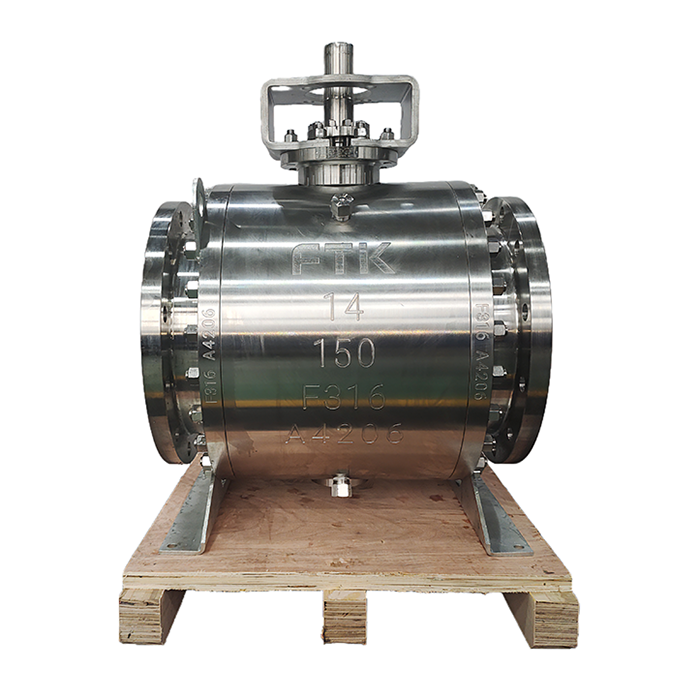
Because the trunnion-supported ball carries the load, the seats only have one job: seal. That is why the design scales to very large sizes and very high pressure classes, where a floating ball valve would load its seats past their limit.
You operate the valve through a stem connected to the ball. A 90-degree turn lines the bore up with the pipe (open) or blocks it (closed). On closing, spring-loaded seats press against the stationary ball to form a tight seal. At low pressure the spring does the work; at high pressure the line force itself reinforces seat contact, so the seal actually gets better as pressure rises.
Most units also include features you will want in severe service: double block and bleed (DBB) for safe isolation and venting, a fire-safe design, and an emergency sealant-injection port. When you are matching a valve to a live pipeline, these are the details that decide whether maintenance stays routine or turns into an outage.
For the people who actually run the plant, the gains show up in three places:
Add double block and bleed plus a fire-safe body, and you have a valve that holds up in pipelines, compressor stations, and tank farms where a floating ball valve would simply work too hard.
Need a trunnion mounted ball valve built to your spec?
Our engineers help you match size, pressure class, seat material, and end connections to your pipeline, then deliver with full API 6D test documentation.
The honest comparison is not “which is better” but “which fits the duty.” A floating ball valve is the economical default for smaller, lower-pressure lines; the trunnion version is the calmer choice once the line gets large or the duty gets hard. Use the table below as a quick check.
| Feature | Floating Ball Valve | Trunnion Mounted Ball Valve |
|---|---|---|
| Ball support | Seats (ball floats) | Trunnion shafts (fixed) |
| Typical size | Up to ~6 in / DN150 | 2–48 in / DN50–DN1200 |
| Pressure class | Low to medium | Medium to high (up to ANSI 1500) |
| Operating torque | Rises with pressure | Low and stable |
| Best fit | General service, smaller lines | High-pressure, large-bore, critical isolation |
If your line is large, high-pressure, or safety-critical, a floating ball valve will fight you on torque. For the deeper engineering trade-offs, our floating vs trunnion engineering guide walks through the math specifiers actually use.
No valve type survives on specification alone; it survives because industries keep asking more of their pipelines. A few shifts are worth naming, because they shape what you should specify next:
None of this means you must buy more valves; it means the engineering case for a fixed, low-torque, bubble-tight design keeps getting stronger as lines get bigger and duties get harder. These trunnion mounted ball valve applications are why the product family keeps expanding across our catalogue.
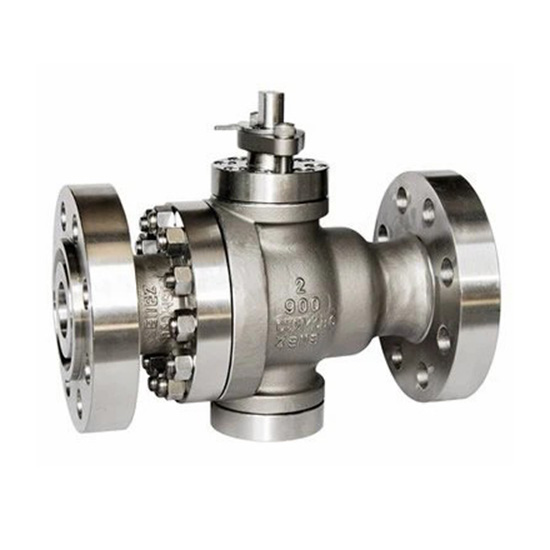
Once you know the duty, the spec follows a familiar path:
For a forged body that removes casting risk on high-pressure lines, our forged trunnion mounted ball valve is a common starting point. Pair it with the right seat and end connection and you have a valve that meets the standards above without a custom redesign.
Not sure which class or seat your line needs?
Send us your size, pressure, temperature, and fluid data. We will return a specification sheet and a quote, typically within two working days.
About FULL-THINK VALVE
FULL-THINK VALVE Co., Ltd. has manufactured industrial valves since 2012 and is an ISO 9001-approved supplier serving oil & gas, petrochemical, power, and water sectors. This guide is written by our engineering team to help specifiers choose with confidence.
Typical off-the-shelf ranges run from 2 in to 48 in (DN50–DN1200) and up to ANSI 1500 class, with forged bodies common above ANSI 600. If your line sits outside that envelope, most manufacturers, including FULL-THINK, will quote a tailored size or class rather than ask you to compromise.
Yes. Because the design already keeps torque low, it pairs well with gear, pneumatic, hydraulic, or electric actuators and with valve position feedback. The ISO mounting pad on the stem makes it straightforward to bolt on the actuator your control system expects, which is why trunnion valves are a frequent choice for remote or unmanned sites.
Side entry valves split the body at the sides and are the workhorse for standard pipeline duty. Top entry valves put the access cover on top, so you can replace seats, seals, and the ball in-line without cutting the valve out of the pipeline. If your plant values fast turnaround maintenance, top entry is worth the premium; for greenfield lines, side entry is usually the cost-efficient default.
With double block and bleed, you isolate both sides, bleed the cavity, and service the seats and seals through the top (on top entry designs) while the valve stays flanged in place. Emergency sealant-injection ports also let you restore sealing temporarily if a seat is scored, buying time until a planned shutdown. That in-line serviceability is a big part of the lifetime-cost case.
They can, with the right seat and body package. Metal-seated versions handle high temperatures (up to roughly 600°C depending on trim), while soft-seat designs with extended bonnets serve cryogenic LNG duty near −196°C. The key is matching the seat material and stem packing to the temperature band, not the trunnion mechanism itself.
Forged bodies remove the internal defects that casting can hide, so they are preferred for high-pressure and sour (H2S) service where a failure is costly. Cast steel is the economical choice for medium-pressure, general-duty lines. If your specification calls for ANSI 600 and above or NACE MR0175, lean forged; below that, cast is usually fine.
(All images are sourced from the internet. In the event of any copyright infringement, please contact us and we will remove the content promptly.)
 Optimized by Seraphinite Accelerator