

The butterfly valve has evolved from a simple low-pressure water component into a high-performance solution capable of handling extreme temperatures and corrosive media. For modern industrial infrastructure, the butterfly valve offers a unique combination of compact design, lower weight, and rapid quarter-turn operation. Since its establishment in 2012, FTK has solidified its position as a premier industrial valve manufacturer, delivering precision-engineered solutions for global water treatment, chemical processing, and energy sectors.
Choosing the right butterfly valve is not merely about pipe size; it requires a deep understanding of body configurations and sealing technologies. As a trusted valve supplier, FTK provides this engineering guide to help technical teams navigate the complexities of Butterfly Valve selection for optimal pipeline performance.
At its core, a butterfly valve consists of a circular disc positioned in the center of the pipe. A rod (stem) passes through the disc to an actuator on the outside of the valve. Rotating the actuator turns the disc either parallel or perpendicular to the flow.
Unlike gate valves, the disc is always present within the flow, which means there is always a slight pressure drop. However, the streamlined design of FTK’s disc profiles minimizes turbulence, ensuring high flow coefficients (Cv values) and reducing the energy requirements for pumping systems.
One of the most critical decisions in the procurement phase is selecting the correct body style. This choice impacts installation speed, maintenance flexibility, and system safety.
The wafer design is the most economical and lightweight option. It is designed to be sandwiched between two pipe flanges using long bolts that span the entire body of the valve. While excellent for space-saving, wafer valves cannot be used as end-of-line valves because removing the downstream piping would cause the valve to fall out.
Lug valves feature threaded metal inserts (lugs) on the valve body. This allows them to be bolted directly to each flange. The primary advantage of a lug-style valve is that it allows for “dead-end service.” You can disconnect the downstream piping while keeping the valve in place under pressure.
Used primarily in large-diameter applications (such as water mains), flanged valves have their own raised faces that match the pipe flanges. These are preferred for heavy-duty infrastructure where structural integrity is the top priority.
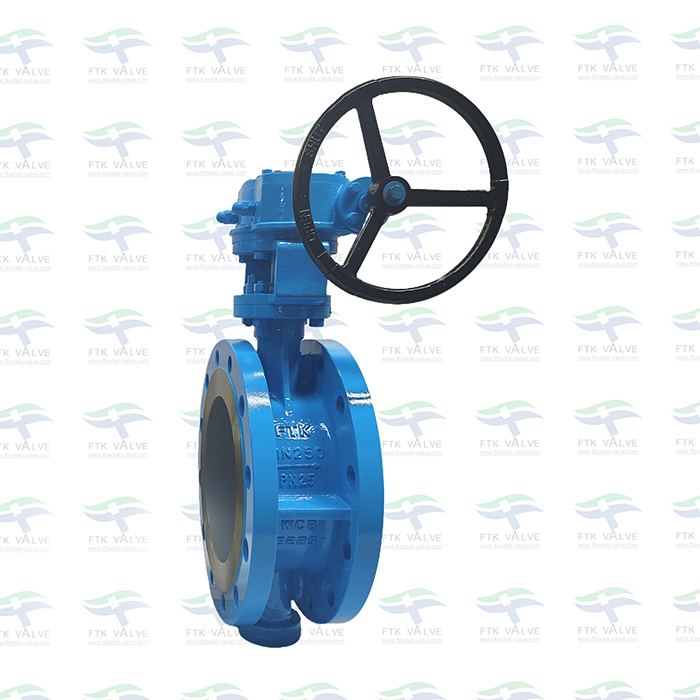
(All images are sourced from the internet. In the event of any copyright infringement, please contact us and we will remove the content promptly.)
In a standard concentric butterfly valve, the stem passes through the centerline of the disc and the centerline of the valve body. These are ideal for low-pressure water and non-abrasive applications. FTK utilizes high-grade resilient seats (EPDM/NBR) to ensure bubble-tight shutoff in these models.
The double offset design features a stem that is offset from the center of the disc and the center of the valve body. This creates a “camming” action. As the valve opens, the disc lifts away from the seat almost immediately, drastically reducing friction and seat wear. This makes them essential for high-cycle applications in chemical and oil sectors.
The third offset is a geometric optimization of the sealing surface. This design eliminates all rubbing between the seat and the disc during the entire 90-degree stroke, allowing for a metal-to-metal seal that remains zero-leakage even in high-temperature steam or volatile gas service.
The sealing surface is the “heart” of the butterfly valve. FTK offers two primary seat configurations:
As emphasized by GlobalSpec, the flow coefficient (Cv) is a vital metric for engineers. A higher Cv means less resistance to flow. FTK engineers optimize the disc thickness-to-strength ratio, ensuring that while the disc is robust enough to withstand high pressure, it remains thin enough to maximize the flow area. This optimization directly leads to lower operational costs over the life of the plant.
A butterfly valve’s lifespan is dictated by its metallurgy. Depending on the media, FTK manufactures valves from a variety of high-performance alloys:
| Feature | Wafer Style | Lug Style | Flanged Style |
| Installation | Between two flanges | Bolted to each flange | Independent flanged joints |
| Weight | Lowest (Compact) | Moderate | Heavy (Robust) |
| End-of-Line Service | No | Yes | Yes |
| Cost | Most Economical | Mid-range | Premium |
| Common Sizes | 2″ to 24″ | 2″ to 24″ | Up to 120″ |
| Best For | General HVAC, Utilities | Maintenance-heavy lines | Large Water/Power Infrastructure |
Modern industrial processes require automated control. FTK butterfly valves are designed with ISO 5211 mounting pads, making them compatible with:
Q1: What is the difference between a concentric and a double offset butterfly valve? A concentric valve has the stem in the center of the disc for basic sealing, while a double offset valve uses a camming action to lift the disc off the seat, reducing wear and torque in high-pressure service.
Q2: Can I use a wafer butterfly valve for dead-end service? No, wafer valves require piping on both sides to remain secured; for dead-end or end-of-line service, a lug-style or flanged butterfly valve must be used.
Q3: How does FTK ensure zero leakage in high-performance valves? Since 2012, FTK has utilized precision-ground discs and high-grade resilient or metal seats that meet API 598 testing standards for bubble-tight shutoff.
Q4: Which butterfly valve is best for abrasive slurries? For abrasive media, a butterfly valve with a hardened metal seat or a reinforced abrasion-resistant elastomer liner is recommended to prevent erosion of the sealing surface.
The high-performance butterfly valve is a masterpiece of modern fluid engineering, offering a balance of efficiency, reliability, and cost-effectiveness. Whether your project requires a simple wafer design for water utility or a sophisticated double offset valve for a chemical refinery, the selection process must be grounded in technical precision.
Since its founding in 2012, FTK has remained a dedicated industrial valve manufacturer, committed to advancing the standards of flow control. By focusing on material integrity and innovative design, we ensure that every valve leaving our facility is ready for the most demanding environments. When you partner with FTK as your valve supplier, you gain access to over a decade of engineering expertise and a full spectrum of Butterfly Valve solutions designed for the future of global industry.