
In global industrial procurement, a pipeline component failure is never just a maintenance issue—it is an operational catastrophe. A single valve blowout can lead to millions of dollars in lost production, environmental fines, and severe workplace safety hazards. For procurement directors, EPC contractors, and pipeline engineers, the process of Choosing a Reliable Valve Manufacturer is the single most critical risk-mitigation step in any capital project.
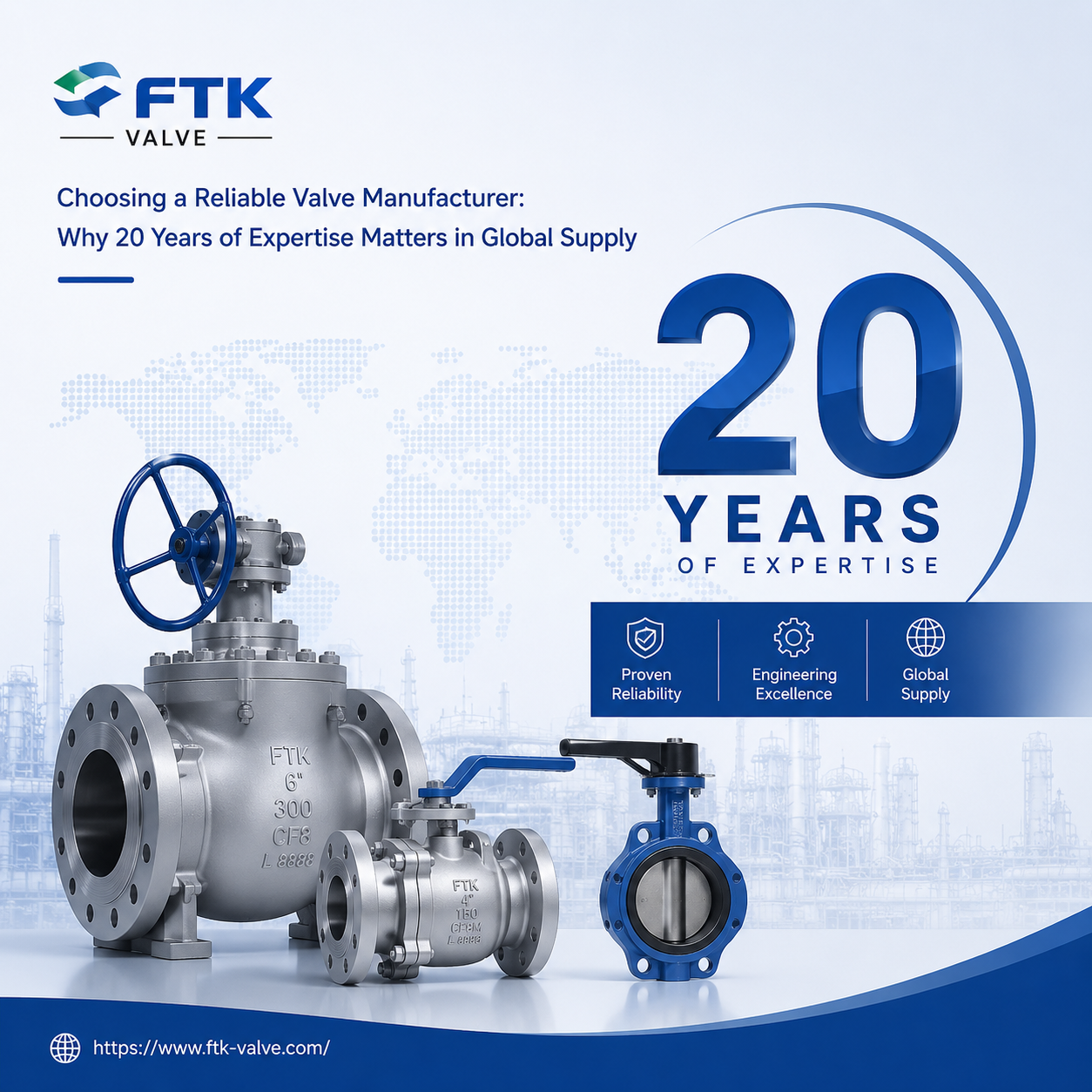
While the global market is flooded with low-cost options, experienced engineering teams know that price is a secondary metric compared to engineering pedigree. At FTK VALVE, established officially in 2012, our brand’s manufacturing backbone and core design engineers carry over 20 years of deep-seated industry expertise in global supply chains. As a trustworthy B2B valves manufacturer, we provide this comprehensive guide to help technical teams evaluate and audit global valves suppliers for long-term project success.
Designing a valve to withstand nominal pressures on paper is simple. Engineering a valve to survive 15 years of continuous thermal cycles, abrasive slurry friction, and corrosive sea-spray requires decades of empirical data. A manufacturer with over 20 years of technical expertise understands the real-world performance limitations of polymers and metals under stress.
The Engineering Benefits of Long-Term Pedigree:
(All images are sourced from the internet. In the event of any copyright infringement, please contact us and we will remove the content promptly.)
When auditing potential valves suppliers, procurement managers must move beyond standard marketing brochures and focus on three uncompromised technical pillars:
A reliable manufacturer must hold internationally recognized quality system credentials. Standard requirements for oil, gas, and chemical supply chains include:
Never rely on a supplier that outsources its quality control testing. A professional Industrial Valve Supplier maintains dedicated testing laboratories capable of executing:
Every dynamic part—from the valve casing and stem down to the smallest seat ring O-ring—must have Mill Test Reports (MTRs) tracing the component back to its exact steel melt batch. This level of traceability prevents the introduction of low-grade recycled iron into severe-service lines.
To assist your project engineering and sourcing teams in auditing potential industrial valve suppliers, utilize our dynamic risk scorecard below to calculate a potential supplier’s reliability score:
Audit and score your prospective valve supplier before signing a contract.
Supplier Safety Rating
As a global B2B buyer, you face a common paradox: Large, century-old conglomerates offer high compliance but suffer from rigid pricing and excruciatingly long 26-week lead times. Conversely, small, uncertified workshops offer low prices but present extreme risks of premature equipment failure.
Established in 2012, FTK resolves this dilemma. Our senior engineering core possesses over 20 years of combined global supply chain expertise, allowing us to combine the quality systems of a Tier-1 conglomerate with the agility and responsiveness of a modern manufacturer.
Q1: Why is an API 6D certification critical for natural gas pipelines?
API 6D is the definitive quality standard for pipeline valves. It enforces highly rigorous wall thickness calculations, face-to-face dimensions, and pressure-holding durations. Without API 6D authorization, a manufacturer’s valves are not certified to handle the dynamic stress and seismic challenges of gas transmission lines.
Q2: What is Positive Material Identification (PMI), and why is it mandatory for corrosive lines?
PMI testing uses an X-ray fluorescence (XRF) gun to confirm the exact element ratios (e.g., Nickel, Chromium, Molybdenum) in metal castings. It prevents low-cost suppliers from mixing cheap carbon steel with expensive stainless alloys, ensuring the valve maintains its designed chemical corrosion resistance in acidic or marine media.
Q3: How does a factory’s tooling and machining equipment affect valve torque?
A spherical ball that is not perfectly round down to the micron level will sit unevenly inside its soft seat ring. This causes tight spots, high wear rates, and unpredictable operational torque spikes that can burn out or damage automated actuators.
Q4: Why does FTK place great emphasis on in-house sandblasting and painting?
External corrosion from humidity, chemical vapors, and seawater is a leading cause of valve stem seizure. By managing surface preparation (sandblasting) and epoxies internally, we guarantee the valve housing remains rust-free for decades under harsh atmospheric conditions.
Q5: Can FTK accommodate custom B2B technical requirements, such as extended stems or bypass systems?
Yes. Because we are an independent, fully integrated manufacturer, our CAD/CAM engineers can easily customize our standard bodies to include extended stems for cryogenic insulation, thermal jackets, or auxiliary bypass systems according to your drawings.
Q6: How do I verify a new valve supplier’s manufacturing capacity?
Always request an actual factory layout map, an equipment asset inventory list (CNC counts, testing bench capacities), and certified documentation of past completed global B2B projects. Professional manufacturers welcome audits via physical on-site visits or digital live-stream walk-throughs.
Q7: Why does a 20-year combined engineering heritage matter if the factory is newer?
A modern factory with advanced CNC machinery is highly efficient, but it requires mature human expertise to program, set up tolerances, and execute strict quality control. Combined engineering expertise ensures the production line operates with proven procedures and robust quality manuals.
Q8: Do FTK valves come with standard EN 10204 3.1 Material Certificates?
Yes. Every shipment leaves our factory with complete, certified EN 10204 3.1 documentation, detailing chemical and mechanical properties, pressure testing logs, and material melt-heat numbers for full transparency.
Q9: What is the main cause of supply chain delays when dealing with valve traders?
Trading companies have no direct control over factory schedules. If a casting foundry is delayed or a test fails, the trader has no physical mechanism to resolve the bottleneck. Working directly with a manufacturer like FTK eliminates middle-man communication gaps and guarantees schedule predictability.
Q10: How does FTK support B2B clients after delivery?
We provide complete field installation manuals, detailed torque calculations for actuator integration, and rapid-response spare parts (seal rings, stems, bearings) directly from our factory inventory to minimize pipeline maintenance downtime.
Ensure maximum safety, precise compliance, and rapid delivery for your pipeline assets. Consult with FTK’s engineering team to request a full technical audit package and factory credentials today.