


Looking for an industrial butterfly valve manufacturer or supplier? There are some basic knowledge to start with. Industrial butterfly valves are widely used in various industries for their compact structure, easy operation, and cost-effectiveness. Whether you’re sourcing for water treatment, petrochemical, or food & pharma applications, understanding the core basics will help you make informed decisions when choosing products from manufacturers or vendors.
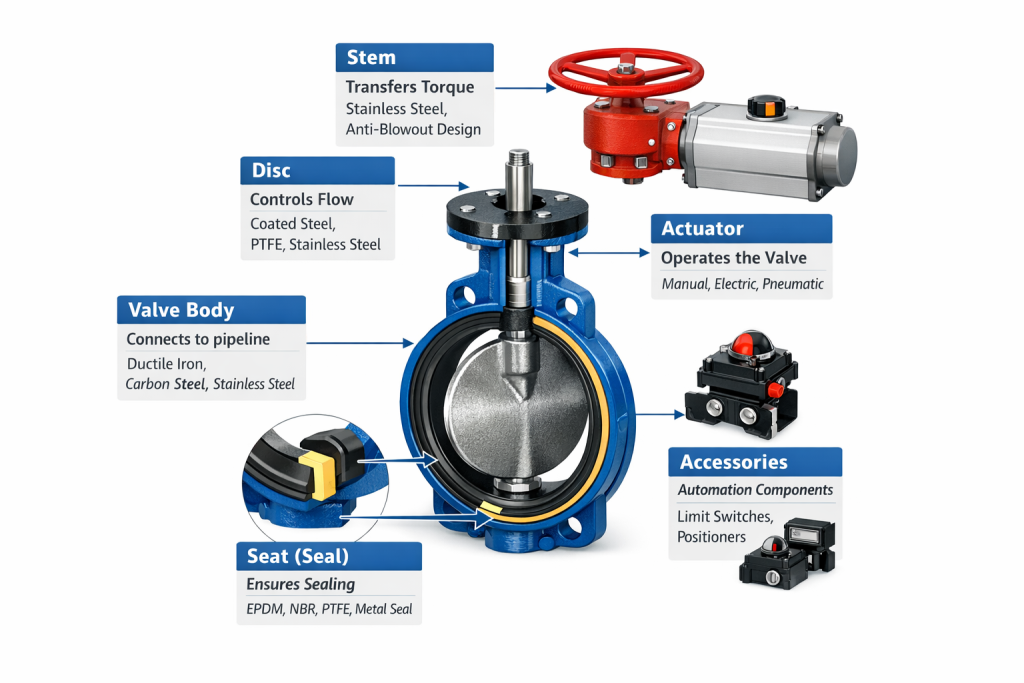
Before selecting a butterfly valve from any manufacturer or vendor, it helps to understand how the valve is built and how each part functions:
(All images are sourced from the internet. In the event of any copyright infringement, please contact us and we will remove the content promptly.)
| Component | What You Need to Know | Common Options |
| Valve Body | Connects to your pipeline and holds all internal parts | Ductile iron, carbon steel, stainless steel |
| Disc | Controls flow by rotating 90° | Coated steel, PTFE, stainless steel |
| Stem | Transfers torque from actuator to disc | Stainless steel, anti-blowout design |
| Seat (Seal) | Determines sealing performance and leakage level | EPDM, NBR, PTFE, metal seal |
| Actuator | Controls how you operate the valve | Manual, electric, pneumatic |
| Accessories | Used in automated systems | Limit switches, positioners |
When you evaluate products from different suppliers, these components—and their materials—directly affect performance, lifespan, and maintenance cost.
(All images are sourced from the internet. In the event of any copyright infringement, please contact us and we will remove the content promptly.)
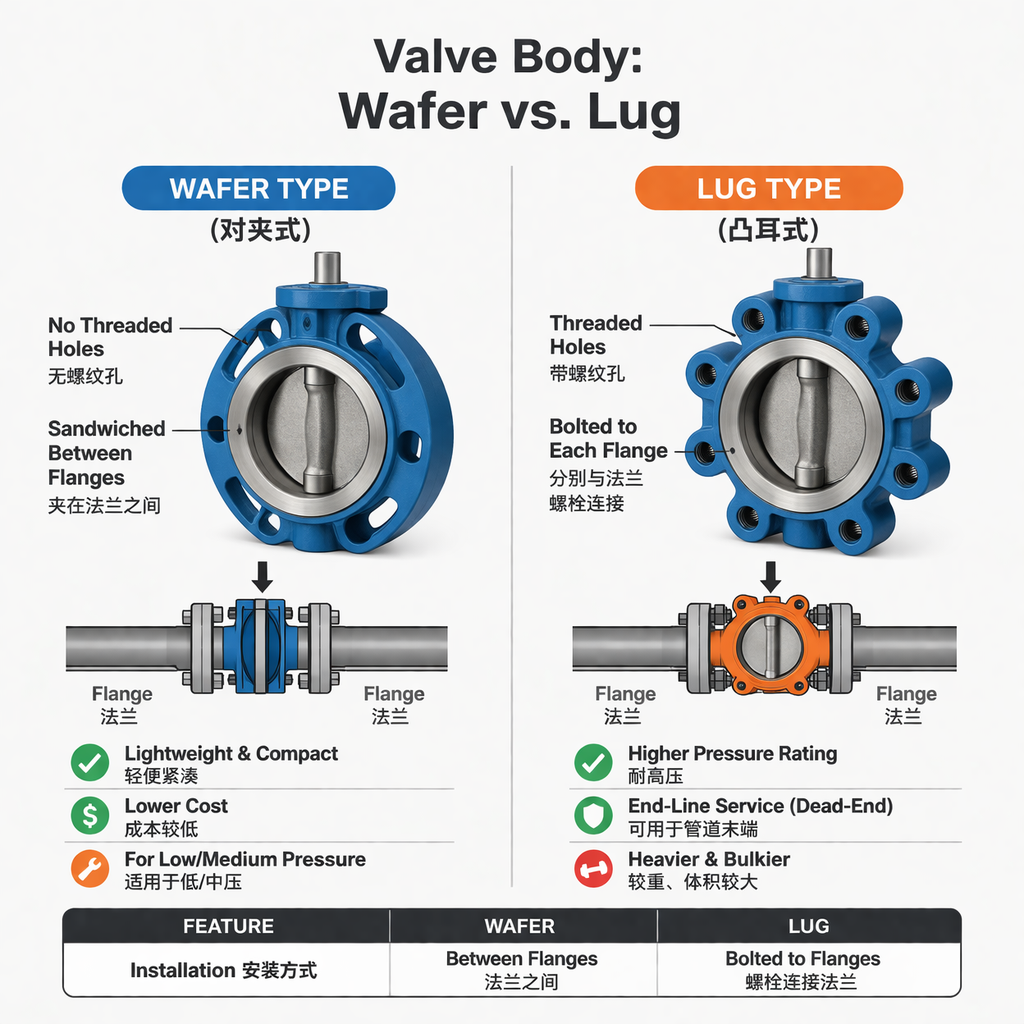
Wafer-style: Fits between flanges, secured with long bolts. It’s affordable, keeps seals tight, and prevents back flow in one-way systems.
Lug-style: Has threaded lugs on both sides. You install it with two bolt sets (no nuts). You can disconnect one pipe side without touching the other. That makes it great for dead-end use.
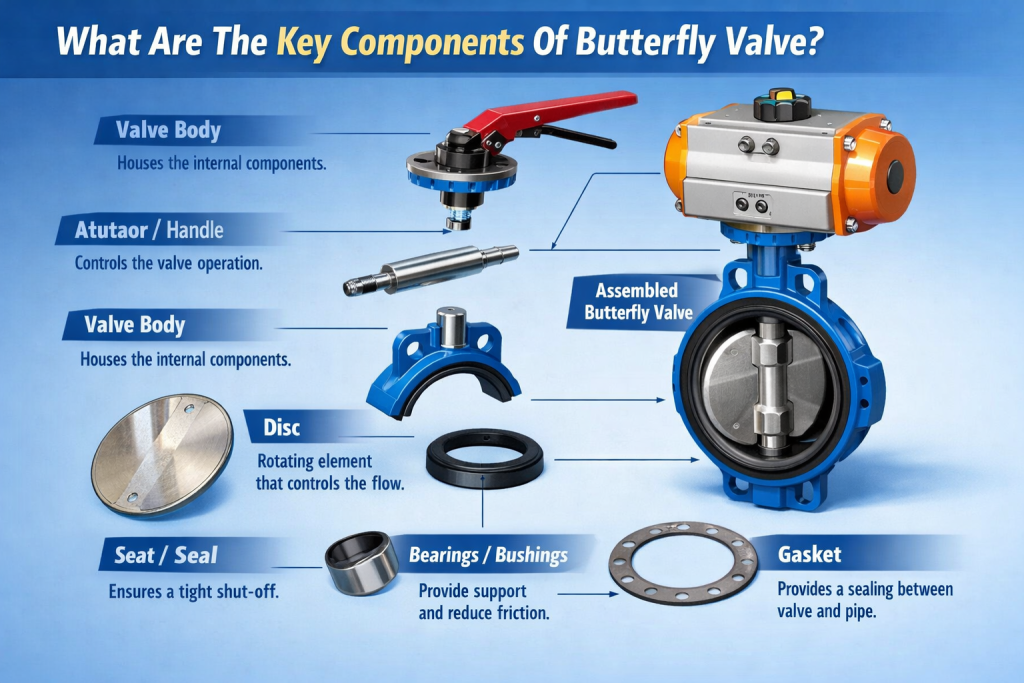
The disc is the one in your pipe’s center which controls flow. It is connected to the actuator via the stem so you can rotate it to open or close. It stays in flow even when open, causing slight pressure drop.
You can normally choose from 3 designs: zero-offset, double-offset, triple-offset.
Zero-offset is made of rubber and bears low pressure.
While triple-offset has less disk-seat contact, perfect for high pressure.
The stem links the disk to the actuator; you’ll pick one-piece or two-piece (split-stem) designs.
Resilient seated valves protect the stem from media, which is a cost-effective material option. High-performance valves need media-compatible, strong stems. Stems are either “wetted” (touches media) or “non-wetted”. You can choose material based on compatibility.
The seat seals the disk and valve body—your choice of material depends on your application:
EPDM: Resists aging/heat/moisture (-40°C to 130°C)
NBR: Great for oil/water (perfect for petroleum pipelines)
PTFE: Resists acids/alkalis (up to 260°C, max 290-320°C)
Metal hard-seal: Handles high temp/pressure, but seals less effectively than soft seats
(All images are sourced from the internet. In the event of any copyright infringement, please contact us and we will remove the content promptly.)
Depending on your industry, your requirements will vary:
| Industry | Typical Media | Common Choice |
| Water Treatment | Water, sewage | Concentric |
| Petrochemical | Oil, steam, chemicals | Triple-offset |
| Power Generation | Cooling water, steam | Double / Triple-offset |
| Food & Pharma | Clean fluids | Stainless steel double-offset |
| Marine | Seawater | Corrosion-resistant valves |
If you’re sourcing from multiple vendors, this kind of mapping can help you quickly narrow down suitable product types.
Choosing the right material of butterfly is significant to avoiding premature failure and reduce maintenance. The material should be based on your system’s working conditions, including media type, temperature, pressure, and corrosion risk. Here’s a practical guide to help you decide:
Corrosive Media (acids, alkalis, seawater): Prioritize stainless steel (304/316) for valve bodies and discs; PTFE or fluorine-lined seats are ideal for enhanced corrosion resistance.
High Temperature (above 200°C): Opt for metal hard-seal seats and heat-resistant materials, such as carbon steel or alloy steel for the body and stem to prevent deformation.
Low Temperature (below -20°C): Choose low-temperature resistant materials, for example stainless steel with special heat treatment and EPDM seats to avoid brittleness.
Food & Pharma Applications: All contact parts must be food-grade stainless steel (316L) and PTFE seats to ensure compliance with hygiene standards and avoid media contamination.
General Service (water, air, low-pressure oil): For most standard, ductile iron bodies, coated steel discs, and EPDM/NBR seats are cost-effective and sufficient.
When you’re evaluating a supplier, it’s not just about the product itself. You’ll also want to look at:
Whether they offer a full range of products; for butterfly valves, we FULL-THINK Valve have concentric, double, and triple-offset types.
Ability to support customization based on your specifications; Besides this, with years of experience, reliable factories also have the ability to remind you when the design doesn’t fit regular usage functions and may need adjustment.
Availability of technical documents; drawings, dimensions, datasheets.
Responsiveness during quotation and after-sales support; You need not only prompt replies from suppliers but also reliable and trustworthy answers. Exaggerated quality commitments and delivery dates can cause endless problems later on.
FTK-Valve, as a manufacturer, provides standard and customized butterfly valve solutions along with supporting technical information to help you align product selection with your project needs.
Any issue about the valves, please do not hesitate to contact us. We are pleased to help you resolve the problem.
Proper installation and regular maintenance are key to extending the service life of your butterfly valve. Here are some tips for daily use:
Ensure the valve is installed in the correct flow direction (marked on the valve body) to avoid back flow and performance issues.
Clean the pipeline before installation to remove debris, rust, or impurities that could damage the seat or disk.
Tighten bolts evenly when installing wafer or lug-style valves to avoid uneven pressure on the seat, which may cause leakage.
You can regularly inspect the valve for leakage, and tighten any loose bolts or connections.Most around the seat and stem.
Lubricate the stem and actuator regularly under the manufacturer’s guidelines, to ensure smooth operation and prevent seizing.
Replace the seat periodically when there is increased leakage or wear, especially For those butterfly valves working in harsh conditions.
Leakage from the seat: Check if the seat is worn or damaged; replace if necessary. Ensure the valve is fully closed.
Difficult operation: Check for stem jamming . Mostly troubleshooting around this area is due to debris or lack of lubrication. Clean and lubricate the stem.
Actuator failure (electric/pneumatic): Inspect power supply/air pressure and connections; refer to the actuator manual for further diagnosis.
Q1: How do you choose between wafer and lug types?
If you need a compact installation, go with wafer. If maintenance access is important, lug is usually the better option.
Q2: When should you upgrade to a triple-offset valve?
When your system involves high pressure, high temperature, or corrosive media, the standard soft seals won’t last.Then you may need upgrade.
Q3: What about fluorine-lined butterfly valves?
If you’re handling aggressive chemicals, PTFE-lined valves are commonly used for corrosion resistance.
Q4: How often should I replace the valve seat?
It depends on working conditions. For general service, every 1-2 years; For harsh conditions such as corrosive, high temp, then you need replace every 6-12 months.
Q5: Can butterfly valves be used for throttling control?
Yes, but it’s recommended for partial flow control only (30%-70% open); excessive throttling may cause cavitation and damage the valve.
Selecting the right industrial butterfly valve is essential to ensuring optimal system performance, reducing downtime, and controlling costs. By understanding key components, material selection, application scenarios, and proper maintenance, you can make informed decisions.
Whether you’re sourcing standard valves or custom solutions, partnering with a reliable manufacturer like FTK-Valve will provide you with the support and quality you need for long-term success.
 Optimized by Seraphinite Accelerator